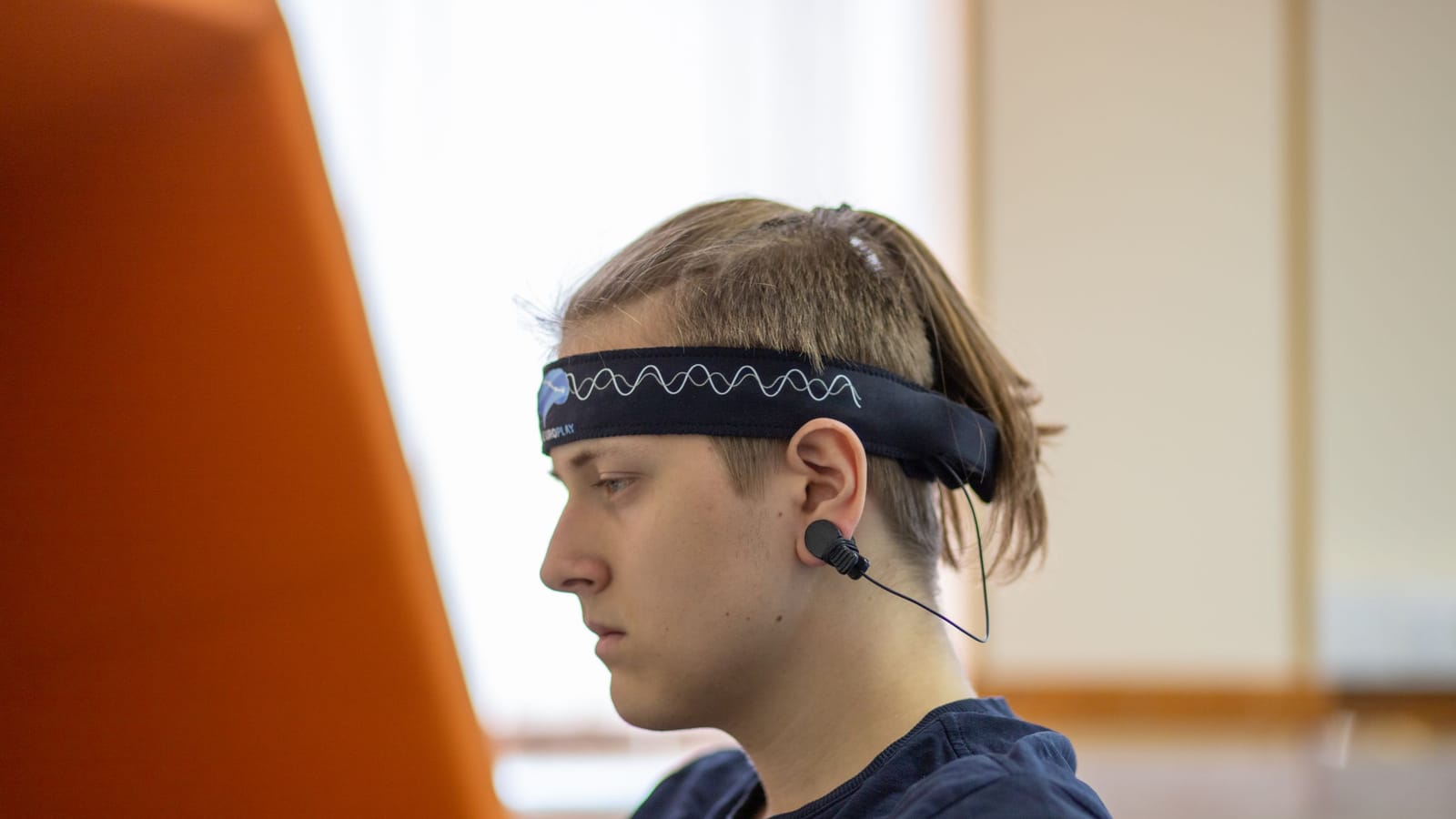
The claim and where it comes from
Transcranial direct current stimulation (tDCS) passes a weak, constant electrical current between electrodes placed on the scalp. Part of the current reaches the brain, and the idea is that it nudges the excitability of the tissue underneath, making neurons slightly more or less likely to fire. Over about 15 years it became popular in both clinical and academic research, with numerous claims that a single session could change cognition in healthy adults, especially working memory and language production [1].
The popular version goes further: a "thinking cap" that sharpens focus, speeds up learning or boosts memory. Because the devices are simple and cheap, they can be bought or built and used at home, which expert guidelines describe as raising ethical and legal concerns about misuse and overuse [5].
The scientific question is narrow. Does a sham-controlled course of stimulation, in healthy people, improve performance on cognitive tasks by a reliable amount? And if it does, does that improvement reach anything beyond the task tested in the lab?
What the studies measured
Well-designed tDCS experiments compare real stimulation with sham stimulation, a procedure made to feel similar without delivering the active stimulation, so that expectation is the same in both groups. Participants then do cognitive tasks during or after stimulation.
| Design feature | What it tells you | What to watch for |
|---|---|---|
| Single session versus repeated sessions | Whether one dose changes performance, or whether a course does | Single sessions are the bulk of healthy-adult research; clinical guidelines rely on repeated sessions |
| Stimulation alone versus stimulation during training | Whether stimulation does something on its own, or only boosts practice | A training effect can be mistaken for a stimulation effect if the sham group trains less |
| Healthy volunteers versus patients | Enhancement versus treatment | Small effects in a clinical group do not imply gains in healthy people |
| Sham control and blinding | Rules out expectation and the experience of being in a study | Whether blinding worked should be checked, not assumed |
| Number of participants | How precise the estimate is | Small studies produce noisy results, and the published ones tend to be the positive ones |
What they found in healthy people
Single sessions. Horvath, Forte and Carter collected single-session tDCS data in healthy adults aged 18 to 50, for every cognitive outcome reported by at least two different research groups [1]. They sorted outcomes into executive function, language, memory and a miscellaneous group, and repeated the analyses with progressively looser inclusion rules [1]. Of 59 analyses, none showed a significant effect, whatever the inclusion rules, and that included every working-memory and language-production outcome [1]. The authors concluded that their review did not support the idea that tDCS produces a reliable effect on cognition in healthy adults [1].
Working memory, a second look. Mancuso and colleagues argued that earlier meta-analyses might have underestimated tDCS, and ran a more comprehensive one focused on the stimulation thought to enhance performance [2]. Across 31 articles, stimulation over a frontal area combined with working-memory training gave a small but significant benefit [2]. The same stimulation without training also improved working memory, but that effect fell to non-significance after correcting for publication bias, and no other analysis was significant [2]. Their conclusion was that any working-memory potential of tDCS probably lies in its use during training [2].
Is the evidence itself solid? Meta-analyses pool published studies, and published studies are more likely to be the positive ones. Medina and Cason used a p-curve, which checks whether the significant results in a literature look like those produced by a real effect [3]. In a random selection of tDCS cognition studies and in the working-memory studies from the Mancuso meta-analysis, they found no evidential value: the estimated power was about 14% for the cognitive studies and 5% for the working-memory studies, which is what randomly generated data would give [3]. They concluded that tDCS studies are likely to be substantially underpowered [3].
Does it change the brain in the way assumed? The theory behind tDCS rests on a large body of neurophysiology. When the same team reviewed 30 neurophysiological measures in healthy adults, each reported by at least two groups, tDCS had a reliable effect on only one: the size of muscle responses evoked by magnetic stimulation of the motor cortex [7]. Even that effect had grown smaller over 14 years of studies [7]. This is mechanism research, so it cannot settle whether tDCS improves thinking, but it removes the assumption that its effects on the brain are well established.
What they found in clinical groups
The picture is different, and more modest, in people with a diagnosed condition, where researchers are trying to treat a problem rather than enhance normal ability.
A 2020 meta-analysis pooled 82 randomised, sham-controlled trials with 2,784 people with schizophrenia, depression, dementia, Parkinson's disease, stroke, traumatic brain injury or multiple sclerosis [4]. Both tDCS and TMS had small effects on working memory (effect size 0.17 each), and tDCS had a small effect on attention and vigilance (0.20); there were no significant effects on processing speed, verbal fluency, verbal learning, executive functioning or social cognition [4]. The authors recommended using these techniques only for realistic aims, such as a small improvement in working memory or attention [4].
European expert guidelines on therapeutic tDCS, based only on repeated-session, sham-controlled studies, found no indication with definite efficacy [5]. They rated it as probably effective for three uses: fibromyalgia, major depressive episodes without drug resistance, and addiction or craving [5]. They rated it as probably ineffective for tinnitus and for drug-resistant depression, and said it remains unclear whether the probable effects are clinically meaningful [5]. None of these are cognitive enhancement in healthy people. If you are considering any brain stimulation for a medical condition, that is a conversation for your doctor.
Conflicting evidence and close relatives
The disagreement between reviews is real, and it follows a familiar pattern: broader or more lenient pooling finds small positive effects, while stricter analyses and bias corrections shrink them. Mancuso and colleagues found a small effect with training [2]; Horvath and colleagues found none for single sessions [1]; the p-curve analysis questioned whether the underlying studies could detect anything at all [3].
A related technique, transcranial alternating current stimulation (tACS), shows the same split. A 2023 meta-analysis of 102 studies with 2,893 people reported modest to moderate improvements across several cognitive domains [8]. A 2024 meta-analysis of tACS and working memory in 1,386 healthy adults found a tiny average effect (g = 0.076) that dropped to zero after correcting for publication bias, while stimulation designed to disrupt brain synchrony reliably made working memory worse [9].
People searching for a way to think better often meet several technologies at once. They differ in what they are and in how strong the evidence is:
| Technique | What it does | Where the evidence stands |
|---|---|---|
| tDCS | Weak constant current through scalp electrodes | No reliable cognitive effect in healthy adults [1]; probable efficacy for a few clinical uses [5] |
| tACS | Weak alternating current at a chosen rhythm | Meta-analyses disagree; near zero for healthy working memory after bias correction [8][9] |
| rTMS | Magnetic pulses from a coil held over the head, in clinics | Definite efficacy for a few clinical uses, such as depression and some neuropathic pain [10] |
| EEG neurofeedback | Feedback from your own brain signals, no current applied | See Does neurofeedback work? |
| Binaural beats | Slightly different tones in each ear | See Do binaural beats work? |
Why home stimulation is a bad idea
Even researchers who work with tDCS have written publicly to DIY users. Their open letter set out risks that go beyond the familiar ones of skin burns and faulty equipment [6]:
- Current spreads through the head and reaches networks well beyond the regions under the electrodes.
- What you are doing during stimulation, and possibly before it, changes the effect.
- Improving one ability may impair another, and such costs may show up only later.
- Effects may last for months or longer, and it is not known whether they are reversible.
- Small changes in settings can produce large or opposite effects; more stimulation is not better, only different.
- People respond very differently, and some respond in the opposite direction to others given identical settings.
The letter notes that most research involves patients who have given informed consent under a risk assessment for their condition, and that healthy users have more to lose [6]. Two of its authors disclosed links with a tDCS device maker [6].
LaserMind's position is simple: tDCS belongs in approved research studies and qualified clinical care. We do not publish protocols, settings or device recommendations, and we encourage you not to follow ones you find online.
What the research says
What this means at LaserMind
We rate tDCS and tACS as clinical or research techniques, not self-improvement methods; our method page says the same. LaserMind offers no stimulation of any kind.
What we do offer is the kind of task these studies use as an outcome. Working-memory experiments often rely on tasks like N-Back, where a square lights up on a 3×3 grid and you press when it is in the same place as N steps back. Practising it makes you better at it; research has not shown that it makes you more intelligent in general, and our game says so on the results screen. Our explainer on working memory describes what these tasks measure, and our review of brain training explains why practice gains tend to stay with the practised task. If your goal is better focus on real work, the Deep Work Timer lets you pick one task and a length of 25, 50 or 90 minutes and counts the distractions you notice. Neither is a substitute for medical care, and neither promises a change beyond what you practise.
Try it on LaserMind
▶ N-BackSee what a working-memory task from this research feels like, starting at 1-back.
Try it on LaserMind
▶ Deep Work TimerPick one real task, set 25 minutes, and count how often your mind wanders.
What research has not established
- Most healthy-adult research tested single sessions in young and middle-aged adults [1]; repeated-session protocols in healthy people have been studied less.
- Stimulation methods vary widely between studies, which makes pooling difficult and allows reviews to reach different conclusions [1][2].
- Clinical findings apply to specific diagnoses under supervision and do not transfer to healthy enhancement [4][5].
- Long-term effects of regular use have not been formally studied [6].
- This article is science education. It is not medical advice and gives no protocols.
Frequently asked questions
Does tDCS make you smarter? There is no reliable evidence that it does in healthy people. A review of single-session studies found no significant effect on any cognitive outcome [1], and the studies reporting gains appear underpowered [3].
Is tDCS used in medicine? It is used and studied in clinical settings. European guidelines found probable, not definite, efficacy for a few uses, such as some cases of depression and fibromyalgia [5]. Ask a doctor about anything related to your own health.
Are home tDCS devices safe? Researchers have warned that effects are unpredictable, may last and may trade one ability against another [6], and guidelines raise ethical and legal concerns about home use [5]. We do not recommend using one.
What is the difference between tDCS and TMS? tDCS applies a weak electrical current through the scalp; rTMS uses magnetic pulses from a coil and has definite efficacy for a small number of clinical uses under specialist care [10].
What the research says
Last evidence check 2026-11-12In research with healthy adults, a meta-analysis found a small working-memory benefit only when tDCS was combined with working-memory training; stimulation alone showed no significant effect once publication bias was corrected. Trained & similar tasks [2]
A re-analysis of published tDCS studies of cognition and working memory in healthy people found no evidential value, because the studies appeared badly underpowered. Trained & similar tasks [3]
References
- Horvath, J. C., Forte, J. D., & Carter, O. (2015). Quantitative review finds no evidence of cognitive effects in healthy populations from single-session transcranial direct current stimulation (tDCS). Brain Stimulation, 8(3), 535–550. https://doi.org/10.1016/j.brs.2015.01.400
- Mancuso, L. E., Ilieva, I. P., Hamilton, R. H., & Farah, M. J. (2016). Does transcranial direct current stimulation improve healthy working memory?: A meta-analytic review. Journal of Cognitive Neuroscience, 28(8), 1063–1089. https://doi.org/10.1162/jocn_a_00956
- Medina, J., & Cason, S. (2017). No evidential value in samples of transcranial direct current stimulation (tDCS) studies of cognition and working memory in healthy populations. Cortex, 94, 131–141. https://doi.org/10.1016/j.cortex.2017.06.021
- Begemann, M. J., Brand, B. A., Ćurčić-Blake, B., Aleman, A., & Sommer, I. E. (2020). Efficacy of non-invasive brain stimulation on cognitive functioning in brain disorders: A meta-analysis. Psychological Medicine, 50(15), 2465–2486. https://doi.org/10.1017/S0033291720003670
- Lefaucheur, J.-P., Antal, A., Ayache, S. S., Benninger, D. H., Brunelin, J., Cogiamanian, F., Cotelli, M., De Ridder, D., Ferrucci, R., Langguth, B., Marangolo, P., Mylius, V., et al. (2017). Evidence-based guidelines on the therapeutic use of transcranial direct current stimulation (tDCS). Clinical Neurophysiology, 128(1), 56–92. https://doi.org/10.1016/j.clinph.2016.10.087
- Wurzman, R., Hamilton, R. H., Pascual-Leone, A., & Fox, M. D. (2016). An open letter concerning do-it-yourself users of transcranial direct current stimulation. Annals of Neurology, 80(1), 1–4. https://doi.org/10.1002/ana.24689
- Horvath, J. C., Forte, J. D., & Carter, O. (2015). Evidence that transcranial direct current stimulation (tDCS) generates little-to-no reliable neurophysiologic effect beyond MEP amplitude modulation in healthy human subjects: A systematic review. Neuropsychologia, 66, 213–236. https://doi.org/10.1016/j.neuropsychologia.2014.11.021
- Grover, S., Fayzullina, R., Bullard, B. M., Levina, V., & Reinhart, R. M. G. (2023). A meta-analysis suggests that tACS improves cognition in healthy, aging, and psychiatric populations. Science Translational Medicine, 15(697), eabo2044. https://doi.org/10.1126/scitranslmed.abo2044
- Chuderski, A., & Chinta, S. R. (2024). Transcranial alternating current stimulation barely enhances working memory in healthy adults: A meta-analysis. Brain Research, 1839, 149022. https://doi.org/10.1016/j.brainres.2024.149022
- Lefaucheur, J.-P., Aleman, A., Baeken, C., et al. (2020). Evidence-based guidelines on the therapeutic use of repetitive transcranial magnetic stimulation (rTMS): An update (2014–2018). Clinical Neurophysiology, 131(2), 474–528. https://doi.org/10.1016/j.clinph.2019.11.002erratum