The claim and where it comes from
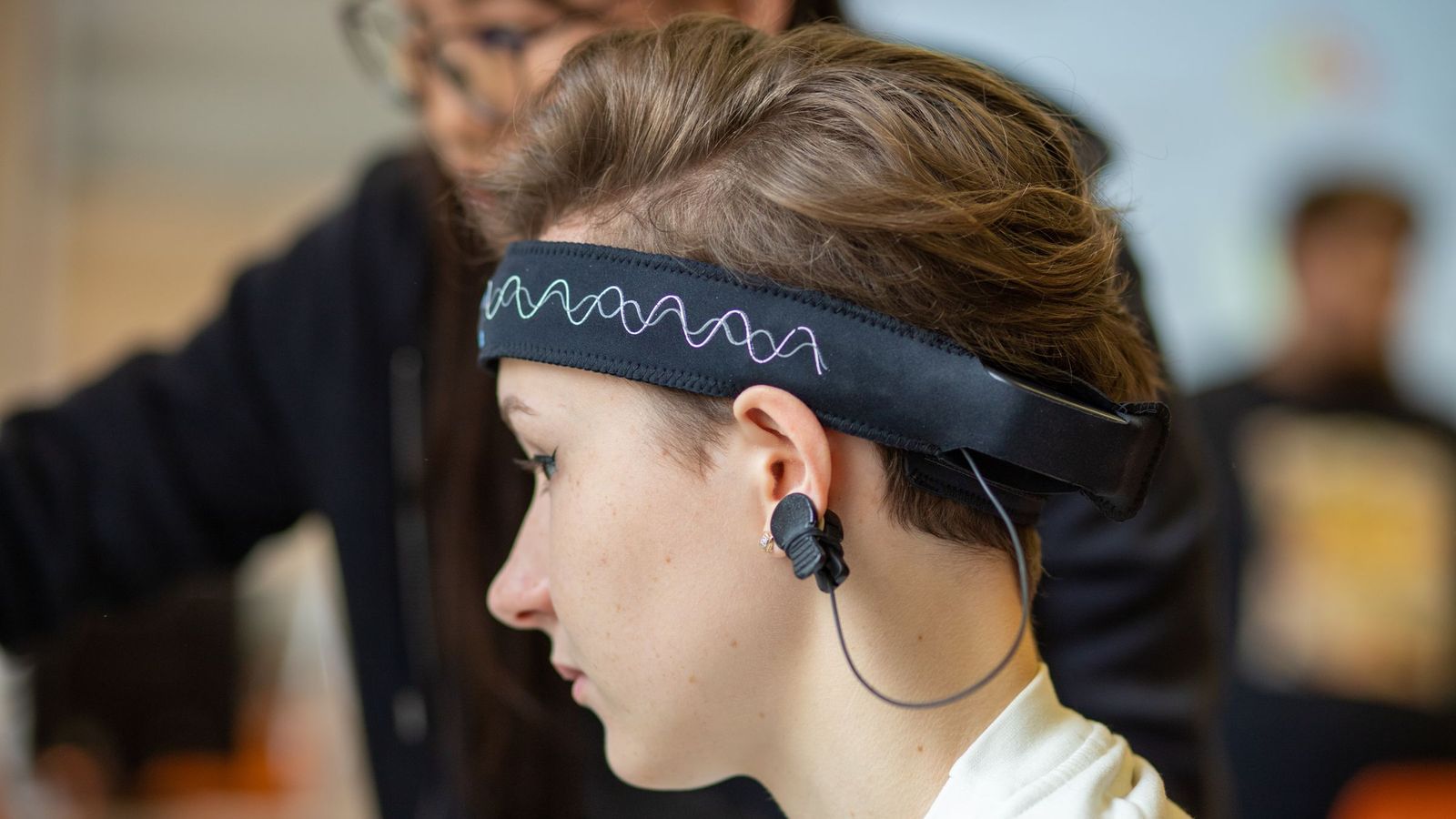
EEG neurofeedback records the brain's electrical activity through electrodes on the scalp and turns part of that signal, usually the strength of one or more frequency bands, into feedback you can see or hear, such as a moving bar, a sound or a game. The aim is to learn to push the selected activity up or down [7]. The principle is learning by reward: whenever the desired pattern appears, you are rewarded, so it should become more likely [3]. In studies with healthy adults, a common target is the sensorimotor rhythm, a band at about 12–15 Hz; others raise alpha or beta power [1]. The largest double-blind trial in ADHD research, described below, trained down the ratio of theta to beta activity [2].
Two kinds of claim are made for it. One is clinical, and ADHD is where it has been studied most. The other is "peak performance": sharper focus and faster thinking for healthy people. A 2014 review of studies in healthy participants listed reported gains in sustained attention, orienting and executive attention, memory, mental rotation, reaction time, complex motor skills, mood and well-being [8]. A list of reported gains is where the claim comes from, not proof that it is true. The question is whether those gains survive a fair comparison.
What the studies measured
Most trials gave a group of people neurofeedback over several sessions and tested them before and after on laboratory tasks, questionnaires or, in clinical studies, symptom ratings. What a trial can show depends on what the neurofeedback group is compared with.
| Comparison group | What it rules out | What it leaves open |
|---|---|---|
| No training or a wait-list | Getting better at the tests simply by taking them twice | Expectation, motivation and the attention of a trainer |
| Sham feedback: identical sessions, but the feedback comes from a recording or from someone else's brain | Expectation and everything else about the sessions, as long as people cannot tell which group they are in | Little: this is the comparison that tests the brain-signal training itself |
| Another activity, such as meditation or a video game | Whether neurofeedback beats an alternative | Whether either one does more than expectation |
The authors of the 2024 meta-analysis put it plainly: improvements in trials with no-intervention control groups can include placebo effects, so a sham comparison is essential to show an effect specific to the trained brain activity [1].
Who rates the outcome matters too. In the ADHD studies, ratings by the people closest to the training setting, such as parents, are the least blinded outcome [4]. Ratings by people who were probably unaware of who had neurofeedback are "probably blinded" outcomes, and neuropsychological tests are analysed separately [5].
What the studies found in healthy people
The main meta-analysis. Kimura and colleagues found 41 randomised trials of neurofeedback for attention in healthy adults and could pool 15 of them, with 569 participants [1]. Most trained EEG signals; a few used fMRI, near-infrared spectroscopy or MEG. Overall, neurofeedback improved performance on attention tests with a small effect (standardised mean difference 0.27, 95% CI 0.10 to 0.44) [1]. Against no intervention, seven trials showed an advantage (0.36, 95% CI 0.003 to 0.73) [1]. Against sham feedback, eight trials showed no significant effect (0.18, 95% CI −0.18 to 0.53), and there was no significant effect on any of the three kinds of attention measured [1]. Training targeted at alpha or sensorimotor-rhythm power showed no significant effect when analysed separately, and more sessions did not go with larger effects [1].
The authors list important limits. Samples were small, about 8 to 25 participants per study; most of the subgroup analyses were underpowered; the review was not preregistered; and only 2 of 41 included studies reported adverse events, neither recording any [1]. Their conclusion was that further sham-controlled trials are needed to confirm any benefit [1].
A review of the better-controlled studies. Rogala and colleagues screened controlled experiments in healthy adults and kept 28 that met stricter criteria for their control groups [7]. The training changed the targeted EEG activity in 17 of the 28 experiments, and behaviour in 10 of the 20 that aimed to change it [7]. They found no evidence that a change in the power of the trained band went with specific changes in behaviour [7], and they described the field as dominated by poorly controlled experiments [7]. They also noted that the 2014 review of peak-performance gains had included several studies without proper controls for non-specific effects [7].
A single sham-controlled study. In a double-blind study, 27 students who scored relatively high on questionnaires about impulsivity and inattention were assigned to neurofeedback or sham feedback, with 30 sessions of 22 minutes planned over 15 weeks [9]. At an interim analysis after 16 sessions, participants did not know which group they were in, and there was no trend towards an effect on a stop-signal task, a continuous-performance task or the questionnaires, so the study was stopped [9].
Memory. A 2023 meta-analysis of EEG neurofeedback for episodic memory, in healthy and clinical participants, pooled 21 studies that had an active control group and found a small effect (g = 0.31) [10]. The same review found that procedures varied considerably and that many studies were underpowered with inadequate design features [10].
The ADHD research: context, not advice
ADHD is the condition in which neurofeedback has been tested most often, and the research makes clear what happens to an effect when the people rating it do not know who had the training. This section is a summary of research for context. It is not advice about ADHD or its care, which belongs with a doctor or another qualified professional.
Blinded versus unblinded ratings. A 2016 meta-analysis of 13 randomised trials with 520 children and teenagers with ADHD found that neurofeedback improved symptoms when rated by the least blinded assessors (standardised mean difference 0.35 for total symptoms, 95% CI 0.11 to 0.59) [4]. The effects were not significant when probably blinded ratings were used, or in trials with active or sham control groups, and the effects on laboratory tests of inhibition and attention were not significant either [4]. Only 4 of the 13 studies checked whether participants had actually learned to change their brain activity [4].
The largest meta-analysis. In 2025, researchers from the same European group pooled 38 randomised trials with 2,472 participants aged 5 to 40 [5]. In probably blinded ratings of total symptoms (20 trials, 1,214 participants), neurofeedback showed no significant improvement (standardised mean difference 0.04, 95% CI −0.10 to 0.18) [5]. Two findings point the other way: a small effect when the analysis was limited to nine trials using established standard protocols (0.21, 95% CI 0.02 to 0.40), and a small improvement in processing speed, the only one of five neuropsychological outcomes to improve [5]. The authors concluded that neurofeedback did not appear to meaningfully benefit people with ADHD at the group level [5].
A large double-blind trial. In a two-site trial, 144 children aged 7 to 10 with moderate or severe ADHD were randomly assigned to theta/beta neurofeedback or to a control of the same length, intensity and appearance, in which the feedback came from prerecorded EEG [2]. Both groups improved a great deal on parent- and teacher-rated inattention (d = 1.5), but neurofeedback was not significantly better than the control at the end of treatment (d = 0.01) or 13 months later (d = 0.23) [2]. At 13 months, the neurofeedback group needed significantly less medication [2]. At 25 months, with 120 of 142 children followed up, the main outcome still did not differ between the groups, and the difference in medication need was no longer significant (57.1% of controls and 38.6% of the neurofeedback group needed medication, p = .059) [11].
Adults. In a triple-blind trial in Germany, 118 adults aged 18 to 60 with ADHD were randomly assigned to 30 sessions of neurofeedback over 15 weeks, to sham neurofeedback or to group therapy [12]. Self-reported symptoms fell substantially in all three groups up to the six-month follow-up, and neurofeedback was not better than sham feedback or group therapy [12].
Analyses that are more favourable. A 2019 meta-analysis of 10 trials with follow-ups of 2 to 12 months, based on parent ratings, found that neurofeedback's advantage over non-active control conditions was still present at follow-up; the authors called for more studies that control for non-specific effects [13]. A 2021 meta-analysis of 17 trials in children reported significant improvement in inattention even when possibly blinded evaluators rated symptoms [14]. Neither changes the central problem: the trials that best hide who had real feedback find little or no specific effect.
Placebo and expectation effects
Why do people who get fake feedback improve too? A neurofeedback course means many sessions of sitting still and concentrating on a screen, often with a trainer, while expecting to get better. A 2017 review argued that few experiments isolate the feedback from the specific brain signal as the active ingredient, and that motivation and expectation, rather than brain changes, seem to drive clinical improvement across many disorders [15]. That is an argument, not a trial, but the trials above fit it.
- In a double-blind study of 25 people with insomnia, 12 sessions of real neurofeedback and 12 sessions of placebo feedback were equally effective on self-reported sleep complaints, and objective sleep measures did not improve [3]. The authors attributed the improvement to non-specific factors such as experiencing trust and receiving care and empathy from the experimenters [3].
- In the children's trial, blinding held well: at 25 months, only about a quarter of those asked could correctly guess the control treatment [11]. The trial authors concluded that most of the large improvement reported in unblinded studies, which they saw again in their own trial, reflects non-specific effects rather than the training of the brain signal [11].
None of this means the improvements people feel are imaginary. It means they are not evidence that changing a brain rhythm is what helped.
Cost, time and consumer headsets
Time. The trials used long courses: 38 sessions in the children's trial [11], 30 sessions over 15 weeks in the adult trial [12], and from 1 to 42 sessions in the healthy-adult trials [1]. The authors of the children's trial built in long follow-ups because, in their words, the expense and effort of neurofeedback can be justified only by enduring benefit [2].
Consumer devices. Home headsets and headbands are a different product from the research systems in these trials. A 2019 policy analysis noted that consumer EEG devices use fewer electrodes and are positioned by the users themselves, not by a trained technician, so it is unclear whether laboratory findings apply to them [6]. Many companies had done little or no original research on whether their products work, and devices that claim to read whether you are stressed, meditative or focused "have not been independently validated and may provide false information" [6]. In the United States, such products can avoid being regulated as medical devices by limiting their claims to wellness, such as "optimizing focus" [6].
A "focus score" on an app is a reading of a signal. It is not evidence that training with it will change your attention, and the research above suggests it is hard to show that even with laboratory equipment.
Conflicting evidence and open questions
- Small effect or no effect? In healthy adults, the overall effect was small and significant, but it was not significant against sham feedback [1]. Only eight trials made that comparison and most subgroup analyses were underpowered, so a small specific effect has not been ruled out; it has not been shown either.
- Memory. One meta-analysis found a small effect on episodic memory against active control groups, alongside many weak designs [10].
- Protocols. In ADHD research, trials using standard protocols showed a small effect in blinded ratings [5], and one meta-analysis found an effect on inattention in possibly blinded ratings [14]. Large sham-controlled trials did not find a specific effect [2][12].
- Learning the signal. Few trials checked whether people learned to control the trained activity [4], and in healthy adults, changes in the trained band did not go with specific changes in behaviour [7].
What the research says
What this means at LaserMind
We grade EEG neurofeedback E3 (limited evidence), because its benefit over sham feedback in healthy people is unclear. For ADHD symptoms, our method page marks the claim as not supported: improvements appeared only in the least blinded ratings. How we review evidence explains the grades. LaserMind does not offer neurofeedback, and none of our exercises reads a brain signal.
What we offer instead is practice with feedback on your behaviour, graded for what it can do:
- Target Watch (Go/No-Go) flashes letters for a quarter of a second. In "Hold back on X" you press for every letter except X, which is about 1 in 9 letters, 72 in a session; in "Catch the X" you press only for X, about 1 in 5 letters, 60 in a session. Levels 1 to 5 shorten the gap between letters, and from level 3 look-alike letters appear. Your results show accuracy, correct presses, presses you should have held back, median response time and d′, a measure of how well you tell the two kinds of letter apart. We grade go/no-go training E2 (conditional evidence), for improving the trained inhibition tasks only, not attention in daily life.
- The Breath Counter asks you to tap the circle, or press Space, on each out-breath, counting from 1 to 10 three times or from 1 to 100. When you notice you have lost count, you press "I lost count" and start again at 1. At the end you see how many breaths you counted, for how many minutes, and how many times you noticed your mind drifting. We grade breath counting E3 (limited evidence), for noticing mind-wandering.
These are practice, not tests, and they do not measure or diagnose attention. Your results are compared with your own earlier sessions; adults can also choose to join leaderboards, which are kept separate for computers and for phones and tablets. For what meditation can and cannot do for attention, see Does meditation improve attention?, and for the everyday causes of poor concentration, see Why can't I focus?.
Try it on LaserMind
▶ Target Watch (Go/No-Go)Play a session of "Hold back on X" and look at how many presses you held back, then compare only with your own later sessions.
Try it on LaserMind
▶ Breath Counter & PacerCount your out-breaths from 1 to 10, and press "I lost count" whenever you notice you have drifted.
Frequently asked questions
Is neurofeedback safe? The trials that reported on safety found no serious problems: in the adult ADHD trial there were no treatment-related serious adverse events [12], and in the children's trial adverse events were spread evenly between real and control feedback [2]. But only 2 of 41 healthy-adult studies reported on adverse events at all [1]. The larger risks are cost, time and putting off a proper assessment.
Can a consumer headset train my focus? There is no good evidence that it can. Consumer EEG devices differ from research systems, and devices that claim to read your mental state have not been independently validated [6]. Even with research equipment, a benefit over sham feedback has not been shown in healthy adults [1].
Is neurofeedback worth trying for attention problems? This article is science education, not advice about any condition. If attention problems affect your work, studies or relationships, or you wonder whether you or your child may have ADHD, talk to a doctor or another qualified professional, who can assess the causes and explain the options that have been tested.
What the research says
Last evidence check 2026-10-19In healthy adults, neurofeedback gave a small overall improvement on attention tests, but no significant benefit in the eight trials that compared it with sham feedback. Trained & similar tasks [1]
In children and teenagers with ADHD, neurofeedback improved symptoms only when rated by the least blinded assessors; effects were not significant with probably blinded ratings or in sham-controlled trials. Health [4]
References
- Kimura, I., Noyama, H., Onagawa, R., Takemi, M., Osu, R., & Kawahara, J. (2024). Efficacy of neurofeedback training for improving attentional performance in healthy adults: A systematic review and meta-analysis. Imaging Neuroscience, 2, imag-2-00053. https://doi.org/10.1162/imag_a_00053
- Neurofeedback Collaborative Group. (2021). Double-Blind Placebo-Controlled Randomized Clinical Trial of Neurofeedback for Attention-Deficit/Hyperactivity Disorder With 13-Month Follow-up. Journal of the American Academy of Child & Adolescent Psychiatry, 60(7), 841–855. https://doi.org/10.1016/j.jaac.2020.07.906
- Schabus, M., Griessenberger, H., Gnjezda, M.-T., Heib, D. P. J., Wislowska, M., & Hoedlmoser, K. (2017). Better than sham? A double-blind placebo-controlled neurofeedback study in primary insomnia. Brain, 140(4), 1041–1052. https://doi.org/10.1093/brain/awx011
- Cortese, S., Ferrin, M., Brandeis, D., et al. (2016). Neurofeedback for attention-deficit/hyperactivity disorder: Meta-analysis of clinical and neuropsychological outcomes from randomized controlled trials. Journal of the American Academy of Child & Adolescent Psychiatry, 55(6), 444–455. https://doi.org/10.1016/j.jaac.2016.03.007
- Westwood, S. J., Aggensteiner, P.-M., Kaiser, A., Nagy, P., Donno, F., Merkl, D., Balia, C., Goujon, A., Bousquet, E., Capodiferro, A. M., Derks, L., Purper-Ouakil, D., Carucci, S., Holtmann, M., Brandeis, D., Cortese, S., Sonuga-Barke, E. J. S., Baeyens, D., Banaschewski, T., … Wong, I. C. (2025). Neurofeedback for Attention-Deficit/Hyperactivity Disorder: A Systematic Review and Meta-Analysis. JAMA Psychiatry, 82(2), 118. https://doi.org/10.1001/jamapsychiatry.2024.3702
- Wexler, A., & Reiner, P. B. (2019). Oversight of direct-to-consumer neurotechnologies. Science, 363(6424), 234–235. https://doi.org/10.1126/science.aav0223
- Rogala, J., Jurewicz, K., Paluch, K., Kublik, E., Cetnarski, R., & Wróbel, A. (2016). The Do's and Don'ts of Neurofeedback Training: A Review of the Controlled Studies Using Healthy Adults. Frontiers in Human Neuroscience, 10. https://doi.org/10.3389/fnhum.2016.00301
- Gruzelier, J. H. (2014). EEG-neurofeedback for optimising performance. I: A review of cognitive and affective outcome in healthy participants. Neuroscience & Biobehavioral Reviews, 44, 124–141. https://doi.org/10.1016/j.neubiorev.2013.09.015
- Logemann, H. N. A., Lansbergen, M. M., Van Os, T. W. D. P., Böcker, K. B. E., & Kenemans, J. L. (2010). The effectiveness of EEG-feedback on attention, impulsivity and EEG: A sham feedback controlled study. Neuroscience Letters, 479(1), 49–53. https://doi.org/10.1016/j.neulet.2010.05.026
- Jackson, L. E., Han, Y.-J., & Evans, L. H. (2023). The efficacy of electroencephalography neurofeedback for enhancing episodic memory in healthy and clinical participants: A systematic qualitative review and meta-analysis. Neuroscience & Biobehavioral Reviews, 155, 105455. https://doi.org/10.1016/j.neubiorev.2023.105455
- Neurofeedback Collaborative Group. (2023). Neurofeedback for Attention-Deficit/Hyperactivity Disorder: 25-Month Follow-up of Double-Blind Randomized Controlled Trial. Journal of the American Academy of Child & Adolescent Psychiatry, 62(4), 435–446. https://doi.org/10.1016/j.jaac.2022.07.862
- Schönenberg, M., Wiedemann, E., Schneidt, A., Scheeff, J., Logemann, A., Keune, P. M., & Hautzinger, M. (2017). Neurofeedback, sham neurofeedback, and cognitive-behavioural group therapy in adults with attention-deficit hyperactivity disorder: a triple-blind, randomised, controlled trial. The Lancet Psychiatry, 4(9), 673–684. https://doi.org/10.1016/S2215-0366(17)30291-2
- Van Doren, J., Arns, M., Heinrich, H., Vollebregt, M. A., Strehl, U., & K. Loo, S. (2019). Sustained effects of neurofeedback in ADHD: a systematic review and meta-analysis. European Child & Adolescent Psychiatry, 28(3), 293–305. https://doi.org/10.1007/s00787-018-1121-4
- Riesco-Matías, P., Yela-Bernabé, J. R., Crego, A., & Sánchez-Zaballos, E. (2021). What Do Meta-Analyses Have to Say About the Efficacy of Neurofeedback Applied to Children With ADHD? Review of Previous Meta-Analyses and a New Meta-Analysis. Journal of Attention Disorders, 25(4), 473–485. https://doi.org/10.1177/1087054718821731
- Thibault, R. T., & Raz, A. (2017). The psychology of neurofeedback: Clinical intervention even if applied placebo. American Psychologist, 72(7), 679–688. https://doi.org/10.1037/amp0000118