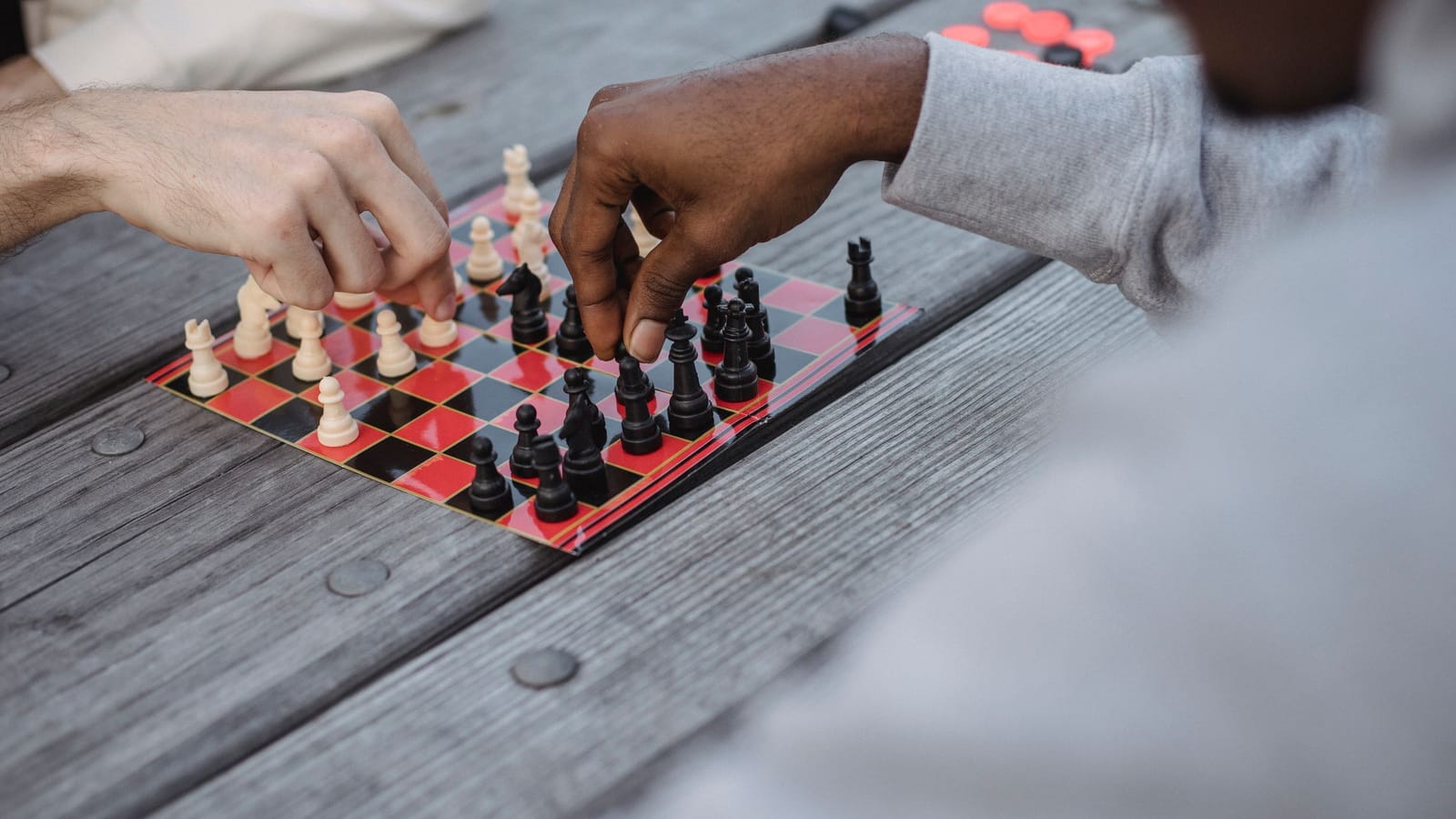
The claim and where it comes from
Chess has an unusual reputation. It is a game, but it is also treated as a kind of mental exercise, a sign of intelligence and, increasingly, a school subject. Several countries have run chess programmes in schools, and in one case a national parliament approved chess courses during school hours [1]. The reasoning usually goes like this: chess demands concentration, memory and logical thinking, so practising it should strengthen those abilities in general, and the gains should show up in mathematics, reading and intelligence tests.
That reasoning is a claim about far transfer: skill learned in one domain improving performance in loosely related ones. It is a strong claim, because decades of research on expertise suggest that skill tends to stay where it was learned [2]. This page looks at what the studies actually found.
For brain training and intelligence in general, see our review of brain games and IQ. For chess as a practice in its own right, see the Chess Strategy method page.
Do chess players have higher cognitive ability?
On average, yes. Summarising their own meta-analytic work, Sala and Gobet report that chess players' overall cognitive ability was higher than non-players' by about half a standard deviation, a moderately large difference [2]. Within chess players, a second meta-analysis found that chess skill correlated with fluid reasoning, processing speed, short-term and working memory, and acquired knowledge such as vocabulary [2].
None of that tells us which way the arrow points. As the same authors put it, an alternative explanation is that people with superior cognitive ability are more likely to take up chess and to excel at it [2]. A correlation between chess and intelligence is what you would expect even if chess did nothing at all for intelligence. To test cause, you need studies that teach chess to some people and not others.
What happens when children are taught chess
A 2016 meta-analysis pooled 24 studies of chess instruction in schools, with 40 effect sizes, 2,788 children in chess groups and 2,433 in control groups [1]. On the surface, the results look encouraging:
| Outcome | Average effect (g) |
|---|---|
| All academic and cognitive outcomes | 0.34 |
| Mathematics | 0.38 |
| Reading | 0.25 |
| Studies with 25 or more hours of chess | 0.43 |
Source: [1].
Longer programmes were associated with larger effects, which the authors took as some support for a real benefit, while noting that placebo effects could not be ruled out [1]. The bigger problem was design. Not one study used what the authors called an ideal design: pre- and post-tests, full random allocation to groups, and both a do-nothing control group and an active control group doing some other new activity [1]. Nearly none had an active control group at all, so any boost from novelty, attention or an enthusiastic instructor would have been counted as a chess effect [1].
The large randomised trial
The most direct test came from England, in a randomised controlled trial involving more than 4,000 children [3]. In contrast to much of the earlier literature, the researchers found no evidence of an effect of chess instruction on children's mathematics, reading or science test scores [3]. They presented the result as a reminder of why robust research designs matter [3].
One trial does not close the question for every age, programme or outcome. But it is a large, randomised test of exactly the claim schools are usually sold, and it came back empty.
Why the effect shrinks as the studies get better
Chess is not a special case. When Sala and Gobet compared chess, music instruction and working-memory training in children, all three showed small to moderate overall effects, and in all three the size of the effect was inversely related to the quality of the design [2]. Against active control groups, the effects were minimal or null [2]. For chess, only one study had an active control group, and its effect was minimal, about 0.10 of a standard deviation [2].
| Kind of evidence | What it found | What it can tell you |
|---|---|---|
| Players vs non-players | Players score higher on cognitive tests | Chess and ability go together; not which causes which |
| School studies, mostly without active controls | Small to moderate gains, larger in maths | Something about the programme helped, or the comparison was unfair |
| Studies with an active control | Minimal effect (one study) | Little left once novelty and expectations are matched |
| Large randomised trial | No evidence of effect on test scores | The school-subject claim did not hold up at scale |
Why would a passive comparison inflate results? Children who get a new weekly activity, a visiting teacher and the message that it will make them smarter may try harder on the post-test. Psychologists have shown that even an active control group does not remove this unless both groups expect the same benefit, and almost no studies check that [6]. Looking across many kinds of training, Sala and Gobet concluded that the effect on general cognitive skills is minimal and that differences between studies are explained by design quality and statistical artefacts [4]. A comprehensive review of commercial brain-training programmes reached a similar verdict: practice improves the practised tasks, with little evidence for everyday cognition [7].
What chess practice does improve
Chess itself. In two large samples of rated tournament players, the amount of serious study they reported doing on their own was the strongest predictor of their rating [5]. A study of 104 Argentinian players, from weak amateurs to grandmasters, reaffirmed that practice matters, but also found large differences between people: the fastest player to reach master level needed about an eighth as much practice as the slowest [8].
Expertise research suggests why the skill stays put. Strong players rely heavily on a large store of familiar patterns of pieces built up over years, knowledge that is specific to chess and hard to carry over to other fields [2]. That is good news if you want to play better chess, and a reason for caution if you hoped chess would do your algebra homework for you.
What the research says
What this means at LaserMind
We do not have a chess game, and we would not sell one as a way to become smarter. Our Chess Strategy method page treats chess as what the evidence supports: a skill you improve by studying positions and games, with feedback.
If what you enjoy about chess is working step by step towards a single right answer, our logic puzzles offer some of the same satisfaction. They are practice on the puzzle itself, and we say so in each game.
- Fleet Logic asks you to place a hidden fleet using row and column counts, with five levels, a daily puzzle and hints that explain each step. A falling solve time on the same level means you are spotting the logical steps sooner on this kind of puzzle; it is not a measure of general reasoning.
- Pattern Logic gives untimed number and shape puzzles and shows the rule after each answer, which is where most of the learning happens.
Our guide to logic puzzles for adults compares puzzle types, and Does brain training work? explains the transfer problem in more depth.
Try it on LaserMind
▶ Fleet LogicTry level 1, then read the hint explanations to see which deductions you missed.
Try it on LaserMind
▶ Pattern LogicAfter each answer, read the rule and check whether you could have spotted it sooner.
What research has not established
- Most school studies were small, short and lacked active control groups, so the true effect is uncertain in both directions [1].
- The large trial tested one school programme with children in England; it does not cover intensive training, adult players or outcomes other than test scores [3].
- Studies of practice and chess rating rely on players' own estimates of how much they studied, often years after the fact [5].
- This page does not cover chess for older adults or in clinical settings, which are separate questions with their own evidence.
Frequently asked questions
Is chess good for your brain? Chess is a demanding, enjoyable skill, and you get better at it with study. There is no good evidence that it improves general intelligence or school results [4][3].
Why are chess players often so clever? On average they do score higher on cognitive tests [2], but that may be because people with higher ability are more likely to take up chess and to do well at it, not because chess raised their ability.
Does chess help children with maths? Early school studies suggested small gains, mainly without proper control groups [1]. A randomised trial with more than 4,000 children found no evidence of an effect on mathematics scores [3].
Is chess better than other brain games? Neither has shown reliable far transfer. Chess, music and working-memory training all show the same pattern of shrinking effects in better-designed studies [2].
What the research says
Last evidence check 2026-11-12In two large samples of rated tournament players, the amount of serious solo study they reported was the strongest predictor of their chess rating. Trained task [5]
Meta-analyses of chess instruction for children found small-to-moderate benefits for cognitive and academic skills, but the better designed the study, the smaller the effect, which casts serious doubt on any real benefit. Other abilities [2]
References
- Sala, G., & Gobet, F. (2016). Do the benefits of chess instruction transfer to academic and cognitive skills? A meta-analysis. Educational Research Review, 18, 46–57. https://doi.org/10.1016/j.edurev.2016.02.002
- Sala, G., & Gobet, F. (2017). Does far transfer exist? Negative evidence from chess, music, and working memory training. Current Directions in Psychological Science, 26(6), 515–520. https://doi.org/10.1177/0963721417712760
- Jerrim, J., Macmillan, L., Micklewright, J., Sawtell, M., & Wiggins, M. (2018). Does teaching children how to play cognitively demanding games improve their educational attainment? Journal of Human Resources, 53(4), 993–1021. https://doi.org/10.3368/jhr.53.4.0516.7952r
- Sala, G., & Gobet, F. (2019). Cognitive training does not enhance general cognition. Trends in Cognitive Sciences, 23(1), 9–20. https://doi.org/10.1016/j.tics.2018.10.004
- Charness, N., Tuffiash, M., Krampe, R., Reingold, E., & Vasyukova, E. (2005). The role of deliberate practice in chess expertise. Applied Cognitive Psychology, 19(2), 151–165. https://doi.org/10.1002/acp.1106
- Boot, W. R., Simons, D. J., Stothart, C., & Stutts, C. (2013). The Pervasive Problem With Placebos in Psychology: Why Active Control Groups Are Not Sufficient to Rule Out Placebo Effects. Perspectives on Psychological Science, 8(4), 445–454. https://doi.org/10.1177/1745691613491271
- Simons, D. J., Boot, W. R., Charness, N., Gathercole, S. E., Chabris, C. F., Hambrick, D. Z., & Stine-Morrow, E. A. L. (2016). Do "brain-training" programs work? Psychological Science in the Public Interest, 17(3), 103–186. https://doi.org/10.1177/1529100616661983
- Gobet, F., & Campitelli, G. (2007). The role of domain-specific practice, handedness, and starting age in chess. Developmental Psychology, 43(1), 159–172. https://doi.org/10.1037/0012-1649.43.1.159