The main types of logic puzzles
| Type | Examples | What you do | On LaserMind |
|---|---|---|---|
| Grid deduction | Ship placement (Bimaru), Sudoku, nonograms, logic grids | Use row, column and region rules to rule cells in or out | Fleet Logic |
| Number puzzles | The 24 game, arithmetic targets, Kakuro | Search combinations of numbers and operations | Make 24 and Make N |
| Pattern and sequence | Number sequences, shape matrices | Find the rule, test it on every term, extend it | Pattern Logic |
| Spatial | Mental rotation, paper folding, tangrams | Turn, fold or fit shapes in your mind | Mental Rotation |
| Word and lateral thinking | Riddles, truth-teller puzzles, cryptic clues | Read statements precisely and question assumptions | Not on LaserMind |
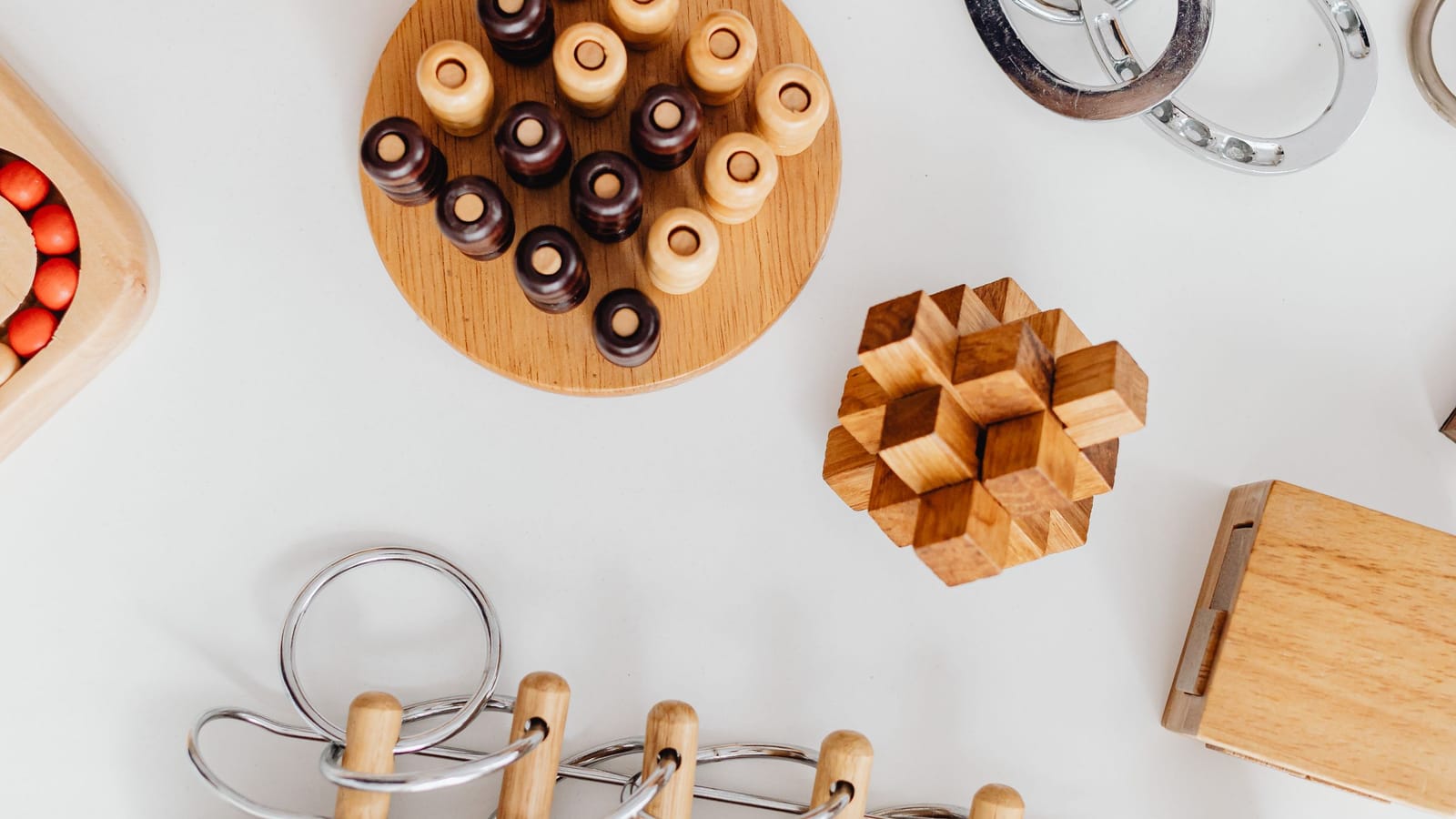
| Mechanical | Wooden interlocking and disentanglement puzzles | Find a sequence of moves by handling the object | Not on LaserMind |
The categories overlap: a nonogram is both a grid and a picture puzzle, and a matrix puzzle is both a pattern and a spatial task. What they share is that there is a correct answer you can reach by reasoning and then check.
Grid deduction puzzles
Grid puzzles give you a set of rules and a few clues, and you fill the grid by ruling possibilities out. In a ship placement puzzle, the numbers beside each row and column say how many ship cells it holds, and ships never touch. A row marked 0 is all water; a row whose open cells exactly match its number is all ship. Harder grids need a short "what if": suppose a cell, follow the rules, and reject the supposition when something breaks.
What it practises: deduction from constraints, keeping track of what is already decided, and testing a hypothesis without guessing. How to Solve Ship Logic Puzzles walks through a full 7 × 7 puzzle step by step, and there is a printable set with answer keys.
Number puzzles
The 24 game gives you four numbers to combine with +, −, × and ÷ to make 24, using each number once. Try 4, 4, 10 and 10.
Show the answer
(10 × 10 − 4) ÷ 4 = 96 ÷ 4 = 24. It is the only solution for this set.
What it practises: mental arithmetic under a goal, and searching systematically instead of trying combinations at random. How to Solve the 24 Game has the strategies; LaserMind's Make 24 also has a harder set with exactly one solution, and Make N, where the target is a number other than 24.
Pattern and sequence puzzles
A sequence puzzle asks what comes next. Try 2, 5, 10, 17, 26, …
Show the answer
The differences are 3, 5, 7 and 9, so the next difference is 11 and the next term is 26 + 11 = 37.
What it practises: forming a hypothesis about a rule and checking it against every term. A short sequence can fit more than one rule, which is why good puzzles are checked so that only one answer fits. Number Sequence Puzzles gives a step-by-step order for finding the rule.
Spatial puzzles
Spatial puzzles ask you to imagine a shape turned, folded or fitted together: is this figure the same as that one rotated, or its mirror image? What does a folded and punched sheet look like when opened? These practise spatial visualisation. Here the training evidence is stronger than for most puzzle types: a meta-analysis of 217 spatial training studies found a moderate average gain that lasted and carried over to untrained spatial tasks, though not beyond spatial tests [1]. See What Is Mental Rotation?.
Word and lateral-thinking puzzles
Riddles, truth-teller puzzles ("one guard always lies…") and cryptic clues rely on reading statements exactly and noticing hidden assumptions. LaserMind does not have these, but they are a good contrast: they depend heavily on language, while grid and number puzzles depend on rules you can see.
What logic puzzles practise, and what they do not
Practising a puzzle type makes you better at that puzzle type. You learn its techniques, spot them sooner and make fewer slips. A large review of brain-training studies found extensive evidence of improvement on trained tasks, less on closely related tasks, and little on distant tasks or everyday performance [2].
The bigger claim, that puzzles make you more intelligent in general, is not supported. A set of meta-analyses on chess, music and working-memory training found small to moderate effects on other skills, but the effects shrank as study quality improved, especially with active control groups; the authors concluded that far transfer rarely occurs [3]. For the evidence on brain games and intelligence, see our review of brain games and IQ.
What about studies showing that puzzle fans score higher? In an online study of 19,078 adults aged 50 to 93, people who reported doing number puzzles more often scored better on all 14 cognitive measures [4]. That is a correlation measured at one point in time. It cannot show that puzzles caused the difference; people with stronger skills may simply enjoy puzzles more. The authors themselves called for further research before treating puzzles as an intervention [4].
How to choose and use logic puzzles
- Start with what you enjoy. You will practise more, and enjoyment is a fine reason in itself.
- Pick puzzles with one checkable answer. Puzzles that are checked for a unique solution let you trust your reasoning; LaserMind's Fleet Logic and Pattern Logic are generated that way.
- Solve without hints first. Use a hint only when stuck, and read why it works before applying it.
- Move up when the current level is comfortable, not when it is merely finished. A good level is one you can solve, but not instantly.
- Keep a simple log of level, time and hints used. Compare only with your own earlier results; How to Measure Progress explains why.
- Vary the type if you want variety, not because switching is proven to build a general skill.
What the research says
Try it on LaserMind
▶ Fleet LogicStart at Level 1 and solve one puzzle without hints.
Try it on LaserMind
▶ Pattern LogicPlay one session of Numbers mode and read the rule shown after each answer.
Try it on LaserMind
▶ Mental Math SprintTry Make 24, then Make N when 24 feels easy.
For a structured way to practise these puzzle types, see the logic puzzles method.
What research has not established
Apart from spatial training, whose gains stay within spatial tests [1], we found no controlled trials of these puzzle types that measured effects beyond the puzzles themselves. The transfer evidence comes from other kinds of training, mostly chess, music and working-memory programmes, studied mainly in children [3], and from a review of commercial brain-training studies [2]. The puzzle-frequency study was cross-sectional, used self-reported puzzle habits and an online volunteer sample aged 50 and over [4]. LaserMind's puzzle levels describe the puzzles, not the person, and are not norms.
Frequently asked questions
What are good logic puzzles for beginners?
Small grid puzzles such as a 6 × 6 ship placement puzzle or a 4 × 4 Sudoku, and short number sequences. They use the same reasoning as larger versions with fewer things to keep track of.
Are logic puzzles good for your brain?
They are good practice at reasoning within the puzzle, and many people find them absorbing. Research has not shown that they improve general intelligence or protect thinking skills; the links found so far are correlations [4].
How much time should I spend on puzzles?
There is no evidence-based dose. Play as much as you enjoy, and if you want to track progress, keep sessions and levels comparable from one week to the next.
References
- Uttal, D. H., Meadow, N. G., Tipton, E., Hand, L. L., Alden, A. R., Warren, C., & Newcombe, N. S. (2013). The malleability of spatial skills: A meta-analysis of training studies. Psychological Bulletin, 139(2), 352-402. https://doi.org/10.1037/a0028446
- Simons, D. J., Boot, W. R., Charness, N., Gathercole, S. E., Chabris, C. F., Hambrick, D. Z., & Stine-Morrow, E. A. L. (2016). Do "brain-training" programs work? Psychological Science in the Public Interest, 17(3), 103–186. https://doi.org/10.1177/1529100616661983
- Sala, G., & Gobet, F. (2017). Does far transfer exist? Negative evidence from chess, music, and working memory training. Current Directions in Psychological Science, 26(6), 515–520. https://doi.org/10.1177/0963721417712760
- Brooker, H., Wesnes, K. A., Ballard, C., Hampshire, A., Aarsland, D., Khan, Z., Stenton, R., Megalogeni, M., & Corbett, A. (2019). The relationship between the frequency of number-puzzle use and baseline cognitive function in a large online sample of adults aged 50 and over. International Journal of Geriatric Psychiatry, 34(7), 932-940. https://doi.org/10.1002/gps.5085