The claim and where it comes from
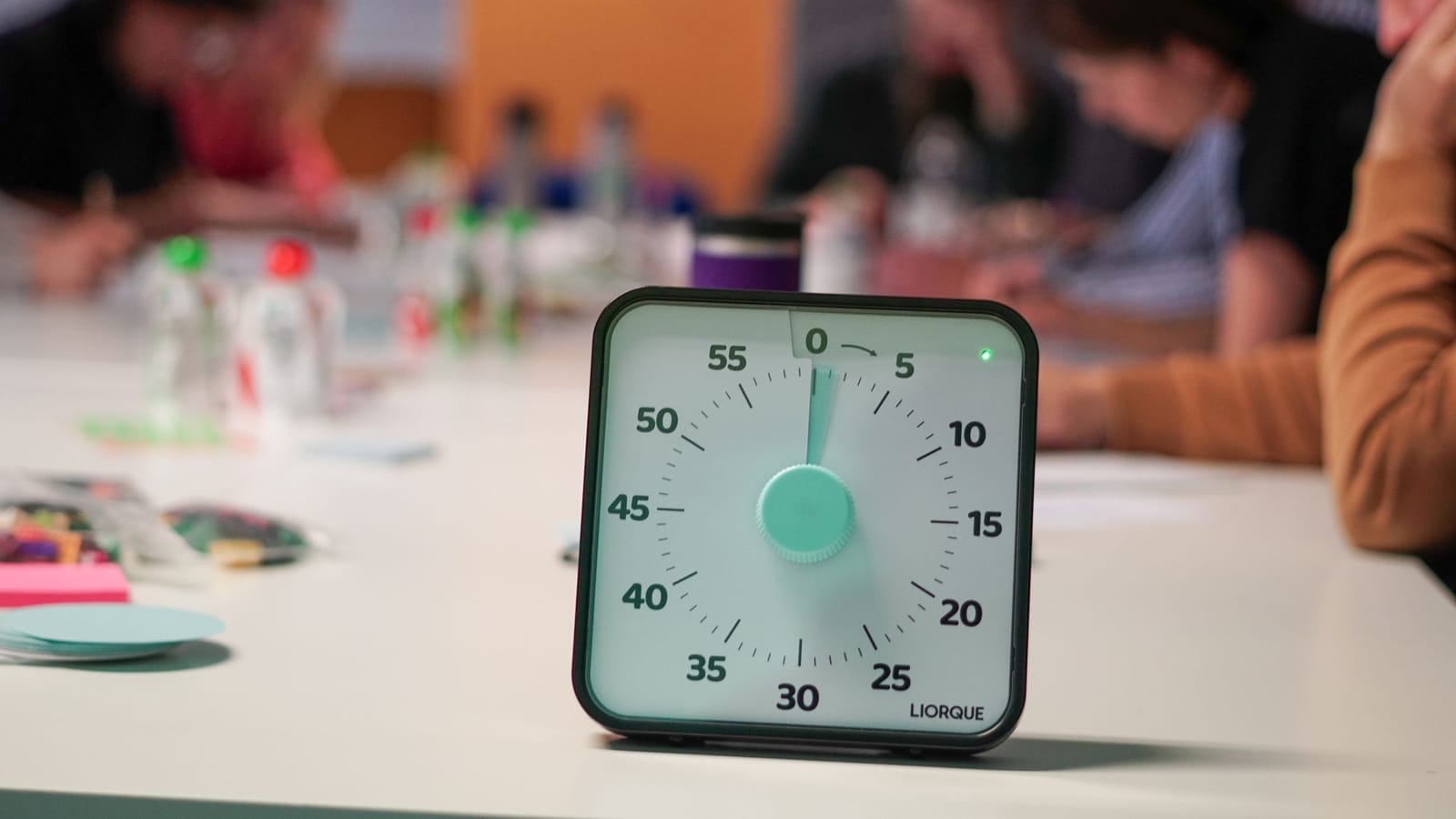
The Pomodoro technique is simple: choose one task, work on it for 25 minutes, take a 5-minute break, and after four rounds take a longer break. It was devised by Francesco Cirillo, who named it after the tomato-shaped kitchen timer he used as a student (pomodoro is Italian for tomato). It spread through productivity books, blogs and apps, and it is now one of the most widely recommended focus methods.
The claims attached to it vary. The modest version says that working in short, fixed blocks makes it easier to start and harder to drift. The bigger versions say that it beats procrastination, prevents burnout, or makes you more productive than any other way of working. Those are different claims, and they need different evidence.
There is a practical question too. Is it the fixed schedule that helps, the breaks themselves, or the fact that you have committed to one task for a set time? Research can only answer these if a study compares Pomodoro with something else, under the same conditions. Very few studies have done that.
What the studies measured
Studies of break schedules usually measure three kinds of outcome. They are worth separating, because a schedule can make you feel better without changing what you get done, or the other way round.
| What is measured | How | What it can and cannot tell you |
|---|---|---|
| How you feel | Repeated self-ratings of fatigue, motivation, concentration, distraction | Mood and effort during the session; not how much you learned |
| What you get done | Self-reported task completion or productivity | Output on the day, as judged by the student; not its quality |
| Flow | Questionnaire about absorption in the task | Whether work felt engaging; not performance |
| Performance on a set task | Accuracy or speed on a lab or work task | Used in break studies generally; not yet in Pomodoro comparisons |
What the research found
Fixed breaks versus self-chosen breaks
In a 2023 study, 87 bachelor's and master's students at a Dutch university followed an online programme during one day of their own real self-study [1]. They were assigned to one of three conditions: take breaks whenever they liked (35 students), take a 6-minute break after every 24 minutes (25 students, the "Pomodoro" condition), or take a 3-minute break after every 12 minutes (27 students) [1].
Students who chose their own breaks studied in longer stretches and took longer breaks. That went with higher fatigue and distraction and lower concentration and motivation than in the two fixed-break groups [1]. There was no difference in how much mental effort students reported investing, and no difference in task completion [1]. The authors concluded that fixed breaks had mood benefits and seemed to bring efficiency benefits: similar task completion in a shorter time [1].
Note what the comparison does and does not show. Both fixed schedules did better than self-chosen breaks on mood, and the shorter 12-and-3 schedule was included alongside the 24-and-6 one [1]. So the study supports some fixed schedule over none, rather than the particular Pomodoro numbers.
Pomodoro versus Flowtime
A 2025 study by a partly overlapping research group tested Pomodoro against two alternatives [2]. Ninety-four university students did one two-hour session of their own studying with online instructions on how to take breaks. One group chose when and how long to break (25 students). The Pomodoro group took 5 minutes after every 25 minutes (36 students). The Flowtime group chose when to stop, but the length of the break was set by how long they had just studied (33 students) [2].
This time the picture was less favourable. Fatigue rose faster under Pomodoro breaks, and motivation fell faster under Pomodoro and Flowtime breaks, than under self-chosen breaks [2]. Yet these differences in the trend did not add up to different overall levels of fatigue or motivation, and the groups did not differ in productivity, task completion or flow [2].
Do short breaks help at all?
The Pomodoro studies sit inside a larger literature on breaks. A 2022 meta-analysis pooled 22 samples with 2,335 participants from experimental and quasi-experimental studies of micro-breaks, defined as breaks of up to 10 minutes [3]. Breaks gave small but statistically significant gains in vigour (d = 0.36) and reductions in fatigue (d = 0.35) [3]. The effect on overall performance (d = 0.16) was not significant; performance improved only on less demanding tasks, and longer breaks went with larger performance effects [3]. The authors suggest that recovering from highly demanding tasks may need breaks longer than 10 minutes [3].
There is also a laboratory idea that gets quoted in support of Pomodoro. In one experiment, people doing a long, monotonous visual vigilance task normally got worse over time; when they were asked occasionally to switch to a brief memory check during the task, that decline was averted [4]. The authors proposed that the brain gets used to a goal held for too long, and that briefly setting it aside refreshes it [4]. That is a mechanism study of a single lab task. It suggests why a pause might help on a long, dull task. It does not test a 25-minute work schedule.
Conflicting evidence and what is missing
The two direct comparisons disagree on the direction of the mood effects. In the 2023 study, fixed breaks looked better than self-chosen breaks [1]; in the 2025 study, the Pomodoro schedule made fatigue rise faster, even if the overall levels ended up the same [2]. On output, both found no difference in task completion [1][2].
There are several reasons to be cautious about both:
- One session each. A single day or a two-hour session cannot tell you whether a schedule helps over a term, or whether people stick with it.
- Students only. Both samples were university students studying their own material, in the 2023 study at a Dutch university [1][2]. Office work, creative work or caring responsibilities may behave differently.
- Self-reports. Productivity and task completion were judged by the students themselves, not by an independent measure of what they produced or learned.
- Small groups. With 25 to 36 students per condition, small differences could be missed.
What has not been tested at all is the claim most people care about: that working in Pomodoros over weeks leads to better learning, more finished work or less procrastination than another sensible way of working.
Why 25 minutes?
Because that is what the technique says. Neither study searched for an ideal length; they used the Pomodoro numbers, or close to them, and compared them with alternatives [1][2]. The 2023 study's shorter 12-and-3 schedule did about as well as 24-and-6 on the measures that differed from self-chosen breaks [1].
| Schedule | Work and break | Tested against others? | What was found |
|---|---|---|---|
| Classic Pomodoro | 25 min, then 5 min | Yes, one session, students | No difference in output or flow; faster rise in fatigue than self-chosen breaks [2] |
| Study's "Pomodoro" | 24 min, then 6 min | Yes, one day, students | Less fatigue and distraction than self-chosen breaks, same task completion [1] |
| Short fixed blocks | 12 min, then 3 min | Yes, one day, students | Similar to the 24-and-6 schedule [1] |
| Flowtime | Stop when you choose; break length set by work time | Yes, one session, students | Faster fall in motivation; no difference in output [2] |
| Longer blocks (50 or 90 min) | Varies | Not in these studies | Unknown; the micro-break review hints that demanding work may need longer breaks [3] |
How to choose a session length
The research does not hand you a number, so the following are suggestions based on what the studies measured, not proven rules.
- Match the block to the task. For a task you are avoiding, a short block lowers the cost of starting; our guide to starting a task you are avoiding covers that in more detail. For writing or problem-solving that takes a while to get into, a longer block may suit you better.
- Decide the break before you start. The 2023 study suggests that people who break whenever they like tend to run longer stretches and feel more tired [1]. A planned stopping point is the part of the method with the most support.
- Make the break a real break. Stand up, move, look away from the screen. The micro-break review found benefits for vigour and fatigue, not for performance on hard tasks [3], so don't expect a break to rescue a demanding task on its own.
- Keep one task per block. Switching between tasks costs time and accuracy; our article on multitasking and task switching explains why.
- Check your own record. After a week or two, compare focused minutes and how often your mind wandered, at different lengths. If 25 minutes feels like an interruption, try 50; if 50 feels like a wall, try 10.
If your problem is less about schedules and more that your mind keeps leaving the task, why can't I focus and what is mind-wandering look at the common causes, and how to focus better gives a broader routine in which Pomodoro is only one option.
What the research says
What this means at LaserMind
Our Deep Work Timer is not a Pomodoro app, though you can use it like one. You name one task and choose a length of 5, 10, 25, 50 or 90 minutes. While it runs, an "I got distracted" button counts each time you notice your mind has left the task, without stopping the clock. You can pause, go full screen or end early, and you can add an optional soft or white noise, which is offered as a sound mask with no claims about effects on the brain. A chime marks the end of the block.
The timer runs one block at a time and does not schedule breaks for you, so the break is your decision: take it, then start another block. Sessions of a minute or more are saved with your focused minutes and distractions per hour. That count is what you notice, not a test, and it can even rise for a while as you get better at noticing, so compare it only with your own earlier weeks. The weekly check-in is a place to look back at what worked. For the method behind single-task blocks, see deep work and single-tasking.
Try it on LaserMind
▶ Deep Work TimerTry one 25-minute block and one 50-minute block on the same kind of task this week, and compare how they felt and what you finished.
What research has not established
- Only two studies have compared Pomodoro breaks with other break schedules, each over one session with university students [1][2].
- Outcomes were mostly self-ratings of mood and self-reported task completion, not measures of learning or work quality.
- The micro-break meta-analysis covered many kinds of tasks and breaks, and most studies were short [3]; it does not test Pomodoro specifically.
- The vigilance experiment used one monotonous laboratory task [4].
- A timer, including ours, can help you structure work; it cannot tell you whether you would have done better another way.
Frequently asked questions
Is the Pomodoro technique scientifically supported? Only weakly. Two one-session studies with students found mixed results: fixed breaks went with better mood than self-chosen breaks in one [1], and the other found no difference in productivity or task completion [2]. Nobody has tested its effect on learning or output over weeks.
Is 25 minutes the best length? No study has shown that. The 2023 study found a 12-minute block with 3-minute breaks about as good as 24 minutes with 6-minute breaks [1]. Choose a length that fits the task and check your own results.
Are breaks good for focus? Short breaks slightly increase vigour and reduce fatigue, but on average they did not improve overall performance, and the benefit for performance showed up only on less demanding tasks [3].
What is the Flowtime technique? You work until you choose to stop, then take a break whose length depends on how long you worked. In the one study that tested it, it did no better than Pomodoro or self-chosen breaks on productivity, task completion or flow [2].
Should I stop using Pomodoro? Not if it works for you. The evidence does not show it is better than other ways of working, but it does not show harm either. Its most defensible parts are deciding on one task and planning your stops in advance.
What the research says
Last evidence check 2026-11-12Switching between tasks costs time and accuracy, even when you can prepare for the switch. Trained task [5]
In a lab experiment, simply receiving phone notifications, without answering them, disrupted performance on an attention-demanding task, an effect the authors describe as comparable to that of actively using a phone. Trained task [6]
References
- Biwer, F., Wiradhany, W., oude Egbrink, M. G. A., & de Bruin, A. B. H. (2023). Understanding effort regulation: Comparing 'Pomodoro' breaks and self-regulated breaks. British Journal of Educational Psychology, 93(S2), 353–367. https://doi.org/10.1111/bjep.12593
- Smits, E. J. C., Wenzel, N., & de Bruin, A. (2025). Investigating the effectiveness of self-regulated, Pomodoro, and Flowtime break-taking techniques among students. Behavioral Sciences, 15(7), 861. https://doi.org/10.3390/bs15070861
- Albulescu, P., Macsinga, I., Rusu, A., Sulea, C., Bodnaru, A., & Tulbure, B. T. (2022). "Give me a break!" A systematic review and meta-analysis on the efficacy of micro-breaks for increasing well-being and performance. PLOS ONE, 17(8), e0272460. https://doi.org/10.1371/journal.pone.0272460
- Ariga, A., & Lleras, A. (2011). Brief and rare mental "breaks" keep you focused: Deactivation and reactivation of task goals preempt vigilance decrements. Cognition, 118(3), 439–443. https://doi.org/10.1016/j.cognition.2010.12.007
- Monsell, S. (2003). Task switching. Trends in Cognitive Sciences, 7(3), 134–140. https://doi.org/10.1016/S1364-6613(03)00028-7
- Stothart, C., Mitchum, A., & Yehnert, C. (2015). The attentional cost of receiving a cell phone notification. Journal of Experimental Psychology: Human Perception and Performance, 41(4), 893–897. https://doi.org/10.1037/xhp0000100
- Hartanto, A., Lua, V. Y. Q., Kasturiratna, K. T. A. S., et al. (2024). The effect of mere presence of smartphone on cognitive functions: A four-level meta-analysis. Technology, Mind, and Behavior, 5(1), 1–14. https://doi.org/10.1037/tmb0000123
- Parry, D. A. (2024). Does the mere presence of a smartphone impact cognitive performance? A meta-analysis of the "brain drain effect". Media Psychology, 27(5), 737–762. https://doi.org/10.1080/15213269.2023.2286647