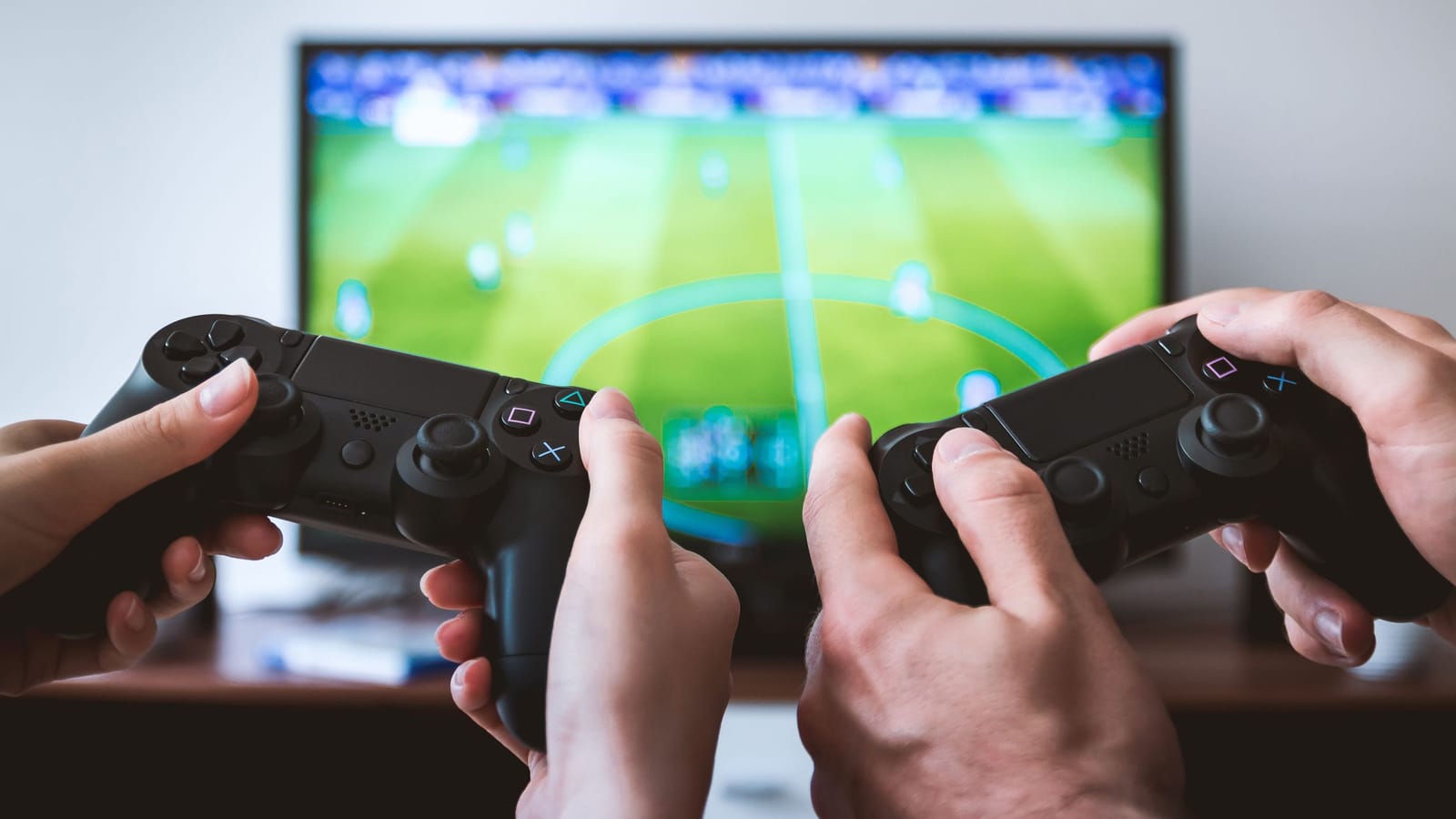
The claim and where it comes from
The modern version of the claim starts with a 2003 paper in Nature. In four experiments, habitual action-game players beat non-players on several tests of visual attention; in a fifth, non-players who trained on an action game improved from their own starting point [6]. The authors noted that learning in perception is usually specific to the trained task, and argued that action games seemed to be an exception [6].
Since then, the idea has split into two claims that are often blurred together. The first is that people who play action games have sharper attention. The second is that playing will sharpen yours. This page is about the evidence for both, and about why careful researchers looking at much the same studies have come to opposite conclusions.
If you want the practical view of game-based practice as a method, see our Action Video Games method page. This page owns the research question: do video games improve cognition, and how sure can we be?
Two kinds of study, two different questions
| Study type | What it compares | What it can show | Main weakness |
|---|---|---|---|
| Cross-sectional | Regular players vs people who rarely play | Whether players differ on lab tests | Cannot separate the effect of playing from who chooses to play |
| Intervention (training) | Non-players assigned to an action game vs a different game, or no game | Whether playing causes a change | Small samples, short training, expectations that differ between groups |
| Correlational | Skill at a game vs scores on cognitive tests | How closely the two go together | Says nothing about direction of cause |
Only the second row can answer the question in the title, so most of this page is about intervention studies.
What the player comparisons found
Here the two camps largely agree on the direction. A 2023 meta-analysis of 105 cross-sectional studies found that action-game players outperformed non-players by a large margin (g = 0.64) [1], and an earlier one covering 2000 to 2015 reported about half a standard deviation (g = 0.55) [7]. The broader 2018 meta-analysis by Sala and colleagues also found differences between players and non-players, but described them as small, and found that skill at video games and overall cognitive ability were only weakly related [2].
The problem is interpretation. A training study from 2008 compared expert gamers with non-gamers and then had non-gamers play more than 20 hours of an action, puzzle or strategy game [3]. Experts were better at tracking fast-moving objects, detecting changes in visual short-term memory, switching between tasks and mental rotation [3]. But extensive practice did not substantially improve the non-gamers on most tasks, apart from some gain in mental rotation [3]. The authors concluded that at least some of the expert advantage reflects far more years of play, or pre-existing differences that lead certain people to become gamers [3].
What the training studies found
The positive estimate. Bediou and colleagues limited the intervention part of their 2023 analysis to studies in which action-game play was compared with an active control group. Across 28 studies and 91 effect sizes, action-game play produced a small improvement in cognitive skills (g = 0.30, 95% CI 0.11 to 0.50) [1]. They did not detect publication bias in this set, though sensitivity analyses pointed to considerable variation between studies, and no moderator, such as the kind of skill tested, was statistically significant [1]. Their 2018 analysis had found a similar intervention effect (g = 0.34), strongest for top-down attention and spatial cognition, while estimating that the published literature overstated average effects by about 30% [7].
The null estimate. Sala, Tatlidil and Gobet ran three meta-analyses with several hundred effect sizes each. Their training analysis pooled 359 effect sizes from studies of many genres and found only a small or null effect, and it concluded that there was no evidence of a causal link between playing video games and better cognitive ability [2]. They also found that longer training did not produce larger effects, which they argued is hard to square with a real training benefit [2].
The reanalysis. Four researchers, including the first author of the broader meta-analysis, reanalysed the studies in the 2018 action-game meta-analysis with stronger corrections for publication bias [4]. They found minimal evidence for transfer to cognitive measures and noted that studies from one laboratory, the senior author's, reported larger effects than others [4]. They also reported that several original studies had spread outcomes from the same or overlapping participants across separate papers without noting the overlap, which can inflate a literature [4]. The 2018 meta-analysis was later corrected on how overlapping participants were clustered, with additional sensitivity analyses [7].
Why the meta-analyses disagree
Reading the papers side by side, four differences stand out.
| Question | Bediou et al. | Sala et al. |
|---|---|---|
| Which games? | Action games only (fast shooters and similar) | All genres, including puzzle and strategy games; titles designed as brain training excluded |
| Which controls? | Active control groups only | Game and non-game control groups, with separate sub-analyses by comparison |
| Bias correction | Bias not detected in the intervention set; heterogeneity flagged | Corrections lowered already small effects towards zero |
| Conclusion | Small causal benefit of action games | No good evidence of a causal benefit |
Genre. "Video games" is too broad a category to test. The action-game camp argues that not all games affect cognition equally, so mixing action games with puzzle or life-simulation games would dilute any effect [7]. The sceptical camp tested that idea too, and found that comparing action-game training with non-action training still gave a small effect that was not statistically significant [2].
Control groups and expectations. Comparing one commercial game with another is a better design than a no-contact control, but it does not guarantee that both groups expect the same benefit. A methods review used video-game training studies as its detailed example of how an active control group can still leave the two groups expecting different amounts of improvement [5]. Almost no studies measure those expectations [5].
Study quality and publication bias. Training studies in this area are often small. When small studies with null results stay unpublished, the average effect looks larger than it is. How strongly to correct for that is a judgement call, and the two camps made different calls [1][4].
What counts as cognition. Most outcomes are laboratory tests of attention, perception and spatial skills. A cross-domain review of cognitive training concluded that far transfer to general cognitive ability is minimal and that differences between studies track their design quality [8], and a comprehensive review of brain-training programmes found little evidence of benefits for everyday cognitive performance [9].
What the research says
What this means at LaserMind
We do not sell video games as cognitive training, and we do not claim that any of our exercises transfer to everyday attention. Two of our games use tasks that appear in this research, so you can see what they involve.
- Number Swarm includes a Track the Dots mode: 8 to 12 identical dots, of which 2 to 5 flash before all of them move for 6 seconds, and you pick out the ones that flashed. It follows the multiple-object-tracking paradigm used in player comparisons. A higher level score means you kept track of more moving targets on this task; it is not a measure of everyday attention. Our explainer on multiple object tracking covers the research behind it.
- Find the Odd One is a visual-search task: many symbols, one different, tap it as quickly as you can without guessing. It reports how much extra time each additional symbol costs you. What is visual search? explains what that number shows.
Use them as practice on these specific tasks and compare only with your own earlier runs on the same device. If you play action games for fun, that is a fine reason to play; the research does not give you a stronger one.
Try it on LaserMind
▶ Number SwarmTry the Track the Dots mode and note how many targets you can follow before you start losing them.
Try it on LaserMind
▶ Find the Odd OneRun a few rounds and watch whether the extra time per symbol changes as the crowd grows.
What research has not established
- Most training studies recruited young adults who rarely played games, trained them for tens of hours, and tested them soon after. Results for children, older adults, long-term players or effects months later are much less clear.
- Outcomes are mostly lab tasks. A gain on a visual-attention test is not the same as better attention while driving, studying or working.
- The two main meta-analyses used different inclusion rules and statistical methods, so their numbers are not directly comparable, and neither settles the question alone [1][2].
- Few studies measured participants' expectations, which can differ even between two active game conditions [5].
Frequently asked questions
Are gamers smarter than non-gamers? Action-game players do better on many attention and perception tests [1], but skill at video games is only weakly related to overall cognitive ability [2], and part of the gap may reflect who chooses to play [3].
Which games have the best evidence? Action games, compared with other commercial games, have the most positive findings, mainly for attention and spatial tasks [7]. Those findings are disputed on grounds of publication bias and overlapping samples [4].
Do brain-training games work better than ordinary video games? Neither has good evidence of improving general cognition. Reviews of both find that practice mostly improves the practised task [9][8].
How many hours would it take? There is no evidence-based dose. In the broad meta-analysis, longer training did not produce larger effects [2], and the action-game researchers have called for more studies with longer training [7].
What the research says
Last evidence check 2026-11-12In 28 studies that compared action games with other games, playing action games gave a small average improvement on cognitive tests, and results varied between studies. Trained & similar tasks [1]
A broader meta-analysis of video-game training found small or null effects overall and no evidence that playing video games causes better general cognitive ability. Other abilities [2]
References
- Bediou, B., Rodgers, M. A., Tipton, E., Mayer, R. E., Green, C. S., & Bavelier, D. (2023). Effects of action video game play on cognitive skills: A meta-analysis. Technology, Mind, and Behavior, 4(1), 28–48. https://doi.org/10.1037/tmb0000102
- Sala, G., Tatlidil, K. S., & Gobet, F. (2018). Video game training does not enhance cognitive ability: A comprehensive meta-analytic investigation. Psychological Bulletin, 144(2), 111–139. https://doi.org/10.1037/bul0000139
- Boot, W. R., Kramer, A. F., Simons, D. J., Fabiani, M., & Gratton, G. (2008). The effects of video game playing on attention, memory, and executive control. Acta Psychologica, 129(3), 387–398. https://doi.org/10.1016/j.actpsy.2008.09.005
- Hilgard, J., Sala, G., Boot, W. R., & Simons, D. J. (2019). Overestimation of action-game training effects: Publication bias and salami slicing. Collabra: Psychology, 5(1), 30. https://doi.org/10.1525/collabra.231
- Boot, W. R., Simons, D. J., Stothart, C., & Stutts, C. (2013). The Pervasive Problem With Placebos in Psychology: Why Active Control Groups Are Not Sufficient to Rule Out Placebo Effects. Perspectives on Psychological Science, 8(4), 445–454. https://doi.org/10.1177/1745691613491271
- Green, C. S., & Bavelier, D. (2003). Action video game modifies visual selective attention. Nature, 423(6939), 534–537. https://doi.org/10.1038/nature01647
- Bediou, B., Adams, D. M., Mayer, R. E., Tipton, E., Green, C. S., & Bavelier, D. (2018). Meta-analysis of action video game impact on perceptual, attentional, and cognitive skills. Psychological Bulletin, 144(1), 77–110. https://doi.org/10.1037/bul0000130
- Sala, G., & Gobet, F. (2019). Cognitive training does not enhance general cognition. Trends in Cognitive Sciences, 23(1), 9–20. https://doi.org/10.1016/j.tics.2018.10.004
- Simons, D. J., Boot, W. R., Charness, N., Gathercole, S. E., Chabris, C. F., Hambrick, D. Z., & Stine-Morrow, E. A. L. (2016). Do "brain-training" programs work? Psychological Science in the Public Interest, 17(3), 103–186. https://doi.org/10.1177/1529100616661983