Mental Rotation
Evidence for: spatial rotation tasks
You look at two shapes and decide whether one is simply the other turned around, or a mirror image of it. It practises turning objects in your mind. Practice helps on spatial rotation tasks; the gains are clearest on these tasks and close variants, and they are not evidence that other kinds of reasoning improve.
Who it suits
A good fit if you
- enjoy visual puzzles and want a spatial exercise that takes a few minutes
- like seeing both accuracy and speed, plus a number for how fast you turn shapes in your head
- work or study with diagrams, maps or 3D shapes and are curious how practice changes your speed on this task
- want a calm, self-paced task; the standard levels have no time limit
Take care or choose something else if
- you expect better reasoning in general: the gains are clearest on rotation tasks and close variants
- staring at shapes strains your eyes or gives you headaches
- you find mirror images hard to tell apart; start with Letters and numbers and go slowly
- you are worried about a change in your thinking or vision: see a doctor; a game score is not a test
How to practise
- Learn the rule with Letters and numbersPress F if the right shape is the left one turned, or J if it is a mirror image. Level 1 uses letters and digits, which are easier to judge because you know which way they should face.
- Pick one feature to followChoose a distinctive part, such as the bar of an F or the end block of a shape, and find it in both. Following one part is easier than turning the whole shape at once.
- Turn the shorter wayA shape turned 300° is only 60° away in the other direction. Turn it back by the smaller angle; the game counts it that way too.
- Turn, then compareIn your mind, turn the right shape until it is upright, then check whether your feature is on the same side. If it is on the other side, it is a mirror image.
- Get it right first, then fasterThe standard levels have no time limit, and answers faster than 150 ms count as errors. Aim for steady correct answers; speed usually follows.
- Move to Block shapes when letters feel easyLevel 2 uses shapes made of squares, which have no familiar right way up. Each session is 24 pairs at angles from 0° to 300° in 60° steps, and the level stays the same for the whole session.
- Try 3D cubes for depthFigures of ten cubes, in the style of the classic Shepard and Metzler shapes, turn about the vertical axis by 0° to 180°. You have 7.5 seconds per pair, which adds a little time pressure.
- Check yourself away from the screenBuild two small shapes from 4–10 toy blocks, have someone turn one, and decide “same” or “mirror” before touching. Then turn them by hand to check. Letters such as F or R drawn at different angles, some flipped, work too.
How much and how often
- Per session
- About 10 minutes: two or three sessions of 24 pairs, with short rests.
- Per week
- 3–4 times a week, on separate days.
- When to make it harder
- Move up a level when you get nearly every pair right with a steady time on two different days. Make it harder with the level, not by rushing.
A four-week starting plan
- Week 1Letters and numbers. Learn the F/J rule and the habit of following one feature.
- Week 2Letters and numbers as a warm-up, then Block shapes.
- Week 3Mostly Block shapes. Notice which angles, and which kind of pair, slow you down.
- Week 4Try 3D cubes once or twice. Compare your Block shapes results with week 2 on the same device.
A sample session
- 0–1 minRest your fingers on F and J, or get ready to tap. Read the rule once and choose your level.
- 1–4 minFirst session of 24 pairs. Focus on getting each pair right.
- 4–5 minRead the result: accuracy, median time and extra time per degree. Look away from the screen for a moment.
- 5–8 minSecond session at the same level. Use the shorter turn and your chosen feature.
- 8–10 minIf you are ready, one 3D cubes or Paper folding session; otherwise a third session at your level. Note your numbers.
Beginner, intermediate and advanced
Beginner
Letters and numbers. Goal: high accuracy with a calm rhythm; time does not matter yet.
Intermediate
Block shapes, keeping an eye on your median time and on which angles slow you down.
Advanced
3D cubes, where the personal record is the median time of right answers and counts only with at least 80% right. Paper folding is a different spatial task you can add for variety.
How to track your progress
- Record accuracy, median time and extra time per degree from the result screen, for each level.
- Compare only with your own results at the same level and on the same kind of device; keys and touch screens give different times.
- A session has only 24 pairs, so the extra time per degree jumps around. Look at the trend over two to four weeks.
- Read faster, accurate answers as “better at rotation tasks”. They do not show that other kinds of reasoning have improved.
Common mistakes
- Tilting your head or the deviceKeep the screen and your head still, so the turning happens in your mind.
- Racing the clockAccuracy comes first. Very fast answers count as errors, and a quick wrong answer teaches you little.
- Turning the long way roundLook for the smaller angle: 300° one way is 60° the other.
- Comparing different levelsLetters, block shapes and cubes differ in difficulty. Compare each level only with itself.
- Treating your speed as an intelligence scoreYour numbers show skill on this task. They are not evidence of wider reasoning gains.
What practice can and can't do
- Getting better at this exercise
- Expected
- Similar tasks (near transfer)
- Sometimes
- IQ, school or work (far transfer)
- Not established
Based on reviews of brain-training research: Simons et al. (2016); Sala & Gobet (2019)
When people judge whether two shapes match, the time they need grows steadily with how far one shape is turned. That pattern is the evidence that people rotate images in their minds, step by step, rather than recognising the turned shape at once.
The extra time per degree on your result screen measures this pattern for you. The finding describes how the task works; it is not evidence that practising it improves other kinds of thinking. That is why LaserMind presents mental rotation as practice for this spatial skill, measured against your own earlier results.
What the research says
Last evidence check 2026-10The time needed to judge whether two shapes match grows steadily with how far one is turned, evidence that people rotate images in their minds. Trained task [1]
References
- Shepard, R. N., & Metzler, J. (1971). Mental rotation of three-dimensional objects. Science, 171(3972), 701–703. https://doi.org/10.1126/science.171.3972.701
Safety
If staring at shapes strains your eyes or gives you a headache, take a short break or stop. Do not play while driving or when you need to attend to something else. Keep small blocks away from young children who might swallow them. A score here is not a medical test; if you are worried about your thinking or vision, see a doctor.
Frequently asked questions
What is the extra time per degree?
It shows how many extra milliseconds each degree of turning added to your correct “same” answers. A smaller number means you turn shapes faster in your mind on this task.
Keys or touch screen?
On a computer, F and J let you keep your eyes on the shapes. Either works; just compare results only with the same way of answering.
Will this make me better at maths or reasoning?
Practice helps on spatial rotation tasks, and the gains are clearest on these tasks and close variants. Do not count on wider benefits.
Which level should I start with?
Letters and numbers. Move to Block shapes once you get nearly every pair right, and try 3D cubes after that.
Related methods
Related reading
Common myths
Is the Mozart Effect Real? What the Studies Actually Found
What the 1993 Mozart study really tested, why the short-lived lift comes from mood and arousal, not Mozart, and how listening differs from learning to play.
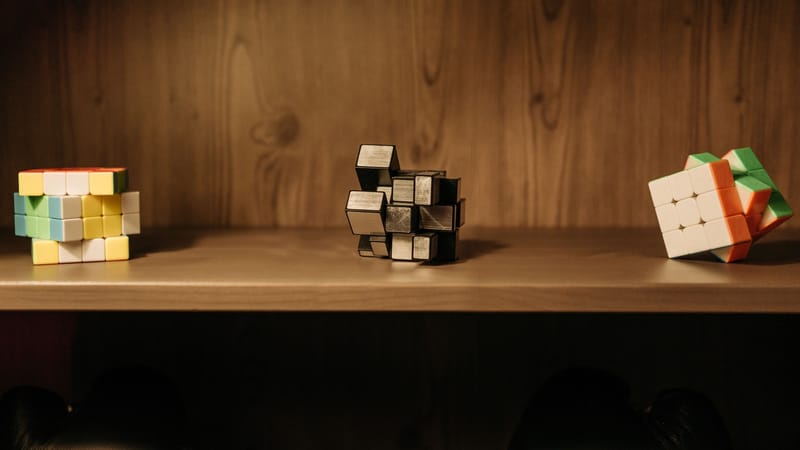
Spatial thinking explained
Mental Rotation: What It Is and How the Test Works
Mental rotation is turning an object in your mind to compare it. How the same-or-mirror test works, why time grows with the angle, and what practice changes.