What is the Corsi block test?
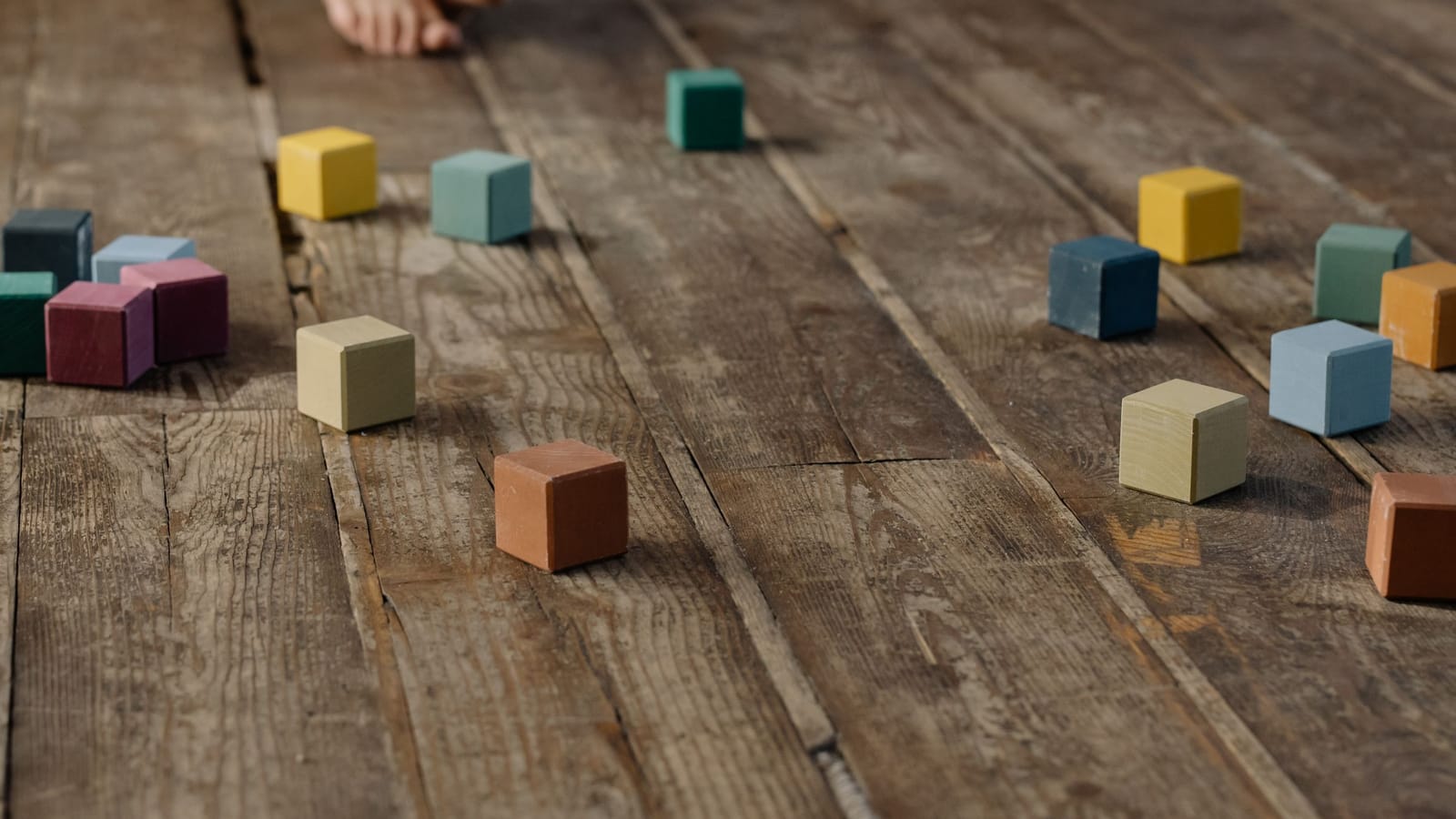
A set of identical blocks is fixed on a board in an irregular arrangement. The examiner touches some of them, one at a time, and you then touch the same blocks in the same order. The sequences get longer until you can no longer reproduce them. The longest sequence you get right is your spatial span, sometimes called the Corsi span.
The task goes back to work by Philip Corsi with Brenda Milner in Montreal in the early 1970s, and by the late 1990s it had become, in the words of one review, arguably the single most important nonverbal task in neuropsychological research [1]. A 2000 study set out a standard way to give and score it and described it as a test of visuospatial short-term memory [2].
Most versions now also have a backward condition, in which you tap the path in reverse. A standardised backward procedure was published in 2008 [3].
How it works: holding where and in what order
To repeat a Corsi path you need two things at once: where each block was and the order in which they lit up. There are no names or numbers to say to yourself, which is why the task is used as a nonverbal counterpart to digit span.
In the working-memory model of Alan Baddeley and Graham Hitch, short-term memory has separate components for speech-based and for visual and spatial material, coordinated by a central executive [4]. On that view, digit span relies mainly on the verbal component and Corsi span mainly on the visuospatial one. The model is a theory that organises many findings, not a map of brain regions.
Dual-task experiments test this idea by adding a second task while you remember the path. In three experiments with a computerised Corsi task [5]:
| Second task during the path | Effect on Corsi recall |
|---|---|
| Tapping a set pattern on a keypad matrix (spatial) | Impaired recall at short and long sequences |
| Generating random time intervals (executive) | Impaired recall, mainly at intermediate and longer sequences |
| Tapping at a fixed, regular rhythm (little executive load) | No effect |
| Saying a word over and over (articulatory suppression, which blocks inner speech) | No effect on forward recall; mixed effects on backward recall |
All rows come from the same study [5]. The pattern suggests that Corsi relies on spatial storage and, as sequences get longer, on executive control too, but not much on inner speech: blocking inner speech left forward recall unaffected.
Corsi span vs digit span
| Digit span | Corsi block test | |
|---|---|---|
| What you remember | A list of digits | A sequence of locations |
| Main type of material | Verbal | Visuospatial |
| Can you name the items? | Yes, easily | Not easily |
| Backward vs forward | Backward is usually harder | Backward is not always harder |
| LaserMind version | Digit Span | Light Path |
The two tasks look alike, but their results do not behave alike. In 246 healthy adults aged 50 to 92 who did both, the scores separated into a verbal and a spatial working-memory factor [3]. Corsi backward was not more difficult than Corsi forward, whereas digit span backward was more difficult than digit span forward [3]. The authors suggested that backward Corsi may rely on the visuospatial store itself, while backward digit span also calls on executive control; that interpretation is still debated.
A review of order-recall studies reached a similar conclusion across many tasks: for verbal material, recalling backwards is usually harder, but for visuospatial sequences it is not always harder, except in people with weaker visuospatial abilities, who do worse backwards [6]. Our article on what the digit span test measures covers the verbal side in detail.
Corsi is not the same as visual working memory
Another family of tasks shows a brief display of coloured squares and asks whether anything changed after a short blank. In those change-detection experiments, people could hold only about four colours or orientations at a time, but could hold several features of each of four objects, which suggests that visual working memory stores whole objects [7]. That is memory for what was in a scene at one moment. Corsi is memory for where, unfolding over time. The two measure related but different things; see What is visual working memory? for the change-detection side.
Why it matters: clinical and research uses
In clinics, the Corsi task is used to assess visuospatial short-term memory after brain injury. In the 2000 standardisation study, the procedure was applied to 70 healthy participants and 70 patients with brain lesions [2]. Using cut-off points from the healthy group, 20% of the patients scored in the borderline range and over 8% in the impaired range, and patients with right-hemisphere damage did worse than those with left-hemisphere damage [2].
These numbers describe a clinical procedure with a specific board, specific instructions and a specific comparison group. They are not norms for an online game. The same applies to the 2008 backward-span data, which were collected to give clinicians regression-based norms and cut-off scores for older adults [3].
In research, Corsi is used as the standard spatial span task alongside verbal span tasks. It is a simple span task: you only hold and reproduce the path, with no second job in between [8]. Our guide to working memory vs short-term memory explains why that classification matters.
What a Corsi score can and cannot tell you
Versions are not interchangeable
The Corsi task has never been given in one uniform way. A 1998 review of 25 years of studies found considerable inconsistency in administration, scoring and the physical test apparatus [1]. A 2021 systematic review of 39 Corsi studies from the previous twenty years found that the lack of methodological consistency persisted and called for a common digital framework [9]. Block layout, how long each block lights up, the gap between blocks, whether you tap on a screen or a wooden board, and whether your score is the longest path or a total of correct trials all change the number you get. So a Corsi span from one version cannot be compared directly with a span from another.
Practice changes the score
Doing a cognitive test again raises the score. Across 50 studies of cognitive ability tests, retesting gave an adjusted average gain of 0.26 standard deviations, more when the identical test form was used [10]. If your spatial span rises over your first sessions, that is expected and says that you are getting better at this task.
Gains stay close to the task
A meta-analysis of working-memory training found reliable short-term gains on working-memory tasks but no convincing transfer to other abilities, including nonverbal ability [11]. A longer Light Path is a fair record of your practice on Light Path; it is not evidence that you will remember where you parked.
What the research says
How LaserMind's Light Path works
LaserMind's Light Path is a practice version of the Corsi task. Nine blocks sit in a fixed, irregular layout, placed so that a position cannot simply be named as a grid cell. They light up one at a time, a little under a second each, with a short gap between them, and no block lights twice in the same path. Then you tap them:
- Forward: tap the blocks in the same order.
- Backward: tap them in reverse order.
- Fast forward and Expert backward: the same tasks with a shorter display (600 ms including the fade, then a 200 ms gap). Their records are kept separately from the standard timing.
The path starts at 2 blocks and can reach 9. You get two tries at each length: if at least one is right, the next path is one block longer; if both are wrong, the round ends. Your answer is checked as soon as you have tapped as many blocks as the path, with no undo and no time limit. Your main number is your spatial span: the longest path you got right at least once. Response time is not measured. Kids mode slows the display and turns off records and ranking.
Because the layout and timing are LaserMind's own, your span is comparable with your own earlier sessions in the same mode, not with clinical cut-offs or with spans from other Corsi apps. Compare Forward with Backward to see your own pattern, and look at the trend over several sessions; How to measure progress in brain training explains why. The Corsi block tapping method page covers how to practise.
Try it on LaserMind
▶ Light Path (Corsi)Play one round Forward and one Backward, and see whether reversing the path is harder for you.
Try it on LaserMind
▶ Change DetectionA different visual memory task: remember a brief display of colours and say whether anything changed.
What research has not established
- The clinical data cited here come from 70 healthy adults and 70 patients with brain lesions, and from 246 healthy adults aged 50 to 92 [2][3]. They may not describe younger adults, children or people using other versions of the task.
- The dual-task evidence comes from laboratory experiments with one computerised version, and articulatory suppression gave inconsistent results for backward recall [5].
- Why backward spatial recall is not always harder is not settled [6].
- Methods vary so much between studies that results from different versions are hard to compare [9].
- LaserMind's Light Path is a practice exercise. It is not standardised, has no population norms and is not a clinical assessment.
Frequently asked questions
What is a normal Corsi span? It depends on the version and the comparison group. Published norms belong to a specific procedure and population [2], and versions differ widely [1]. On Light Path, compare your span with your own earlier sessions in the same mode.
Is the Corsi test a working-memory test? Forward Corsi is usually classed as a simple span task, a measure of visuospatial short-term memory [8][2]. Executive control does contribute, especially for longer paths [5].
Why is my backward path as long as my forward path? For spatial sequences that is common; unlike digits, reversing a path is not always harder [6][3].
Can an online Corsi test show brain damage or dementia? No. Clinical use depends on a standard procedure, trained administration and norms [2]. If you are worried about your memory, talk to a doctor or another qualified professional.
What the research says
Last evidence check 2026-11-12The Corsi block-tapping test is a standard measure of visuospatial short-term memory; this study standardised how it is given and scored. Trained task [2]
A meta-analysis of working-memory training found reliable short-term gains on working-memory tasks, which did not last well, and no convincing transfer to verbal or nonverbal ability, word decoding or arithmetic. Trained & similar tasks [11]
References
- Berch, D. B., Krikorian, R., & Huha, E. M. (1998). The Corsi block-tapping task: Methodological and theoretical considerations. Brain and Cognition, 38(3), 317–338. https://doi.org/10.1006/brcg.1998.1039
- Kessels, R. P. C., van Zandvoort, M. J. E., Postma, A., Kappelle, L. J., & de Haan, E. H. F. (2000). The Corsi Block-Tapping Task: Standardization and normative data. Applied Neuropsychology, 7(4), 252–258. https://doi.org/10.1207/S15324826AN0704_8
- Kessels, R. P. C., van den Berg, E., Ruis, C., & Brands, A. M. A. (2008). The backward span of the Corsi Block-Tapping Task and its association with the WAIS-III Digit Span. Assessment, 15(4), 426–434. https://doi.org/10.1177/1073191108315611
- Baddeley, A. D., & Hitch, G. (1974). Working memory. Psychology of Learning and Motivation, 8, 47–89. https://doi.org/10.1016/S0079-7421(08)60452-1
- Vandierendonck, A., Kemps, E., Fastame, M. C., & Szmalec, A. (2004). Working memory components of the Corsi blocks task. British Journal of Psychology, 95(1), 57–79. https://doi.org/10.1348/000712604322779460
- Donolato, E., Giofrè, D., & Mammarella, I. C. (2017). Differences in Verbal and Visuospatial Forward and Backward Order Recall: A Review of the Literature. Frontiers in Psychology, 8, 663. https://doi.org/10.3389/fpsyg.2017.00663
- Luck, S. J., & Vogel, E. K. (1997). The capacity of visual working memory for features and conjunctions. Nature, 390(6657), 279–281. https://doi.org/10.1038/36846
- Aben, B., Stapert, S., & Blokland, A. (2012). About the Distinction between Working Memory and Short-Term Memory. Frontiers in Psychology, 3, 301. https://doi.org/10.3389/fpsyg.2012.00301
- Arce, T., & McMullen, K. (2021). The Corsi Block-Tapping Test: Evaluating methodological practices with an eye towards modern digital frameworks. Computers in Human Behavior Reports, 4, 100099. https://doi.org/10.1016/j.chbr.2021.100099
- Hausknecht, J. P., Halpert, J. A., Di Paolo, N. T., & Moriarty Gerrard, M. O. (2007). Retesting in selection: A meta-analysis of coaching and practice effects for tests of cognitive ability. Journal of Applied Psychology, 92(2), 373–385. https://doi.org/10.1037/0021-9010.92.2.373
- Melby-Lervåg, M., & Hulme, C. (2013). Is working memory training effective? A meta-analytic review. Developmental Psychology, 49(2), 270–291. https://doi.org/10.1037/a0028228