What is flash anzan?
Anzan (暗算) is the Japanese word for mental calculation. In soroban schools it usually means calculating with a mental image of the abacus instead of the physical one. Flash anzan presents the numbers in a fast sequence on a screen, for example fifteen three-digit numbers, each visible only for a fraction of a second, and the student writes or says the total.
It is both a training format and a competition event. The difficulty can be raised in several ways: more numbers, more digits per number, shorter display times, or subtractions mixed in.
How it works: the mental abacus
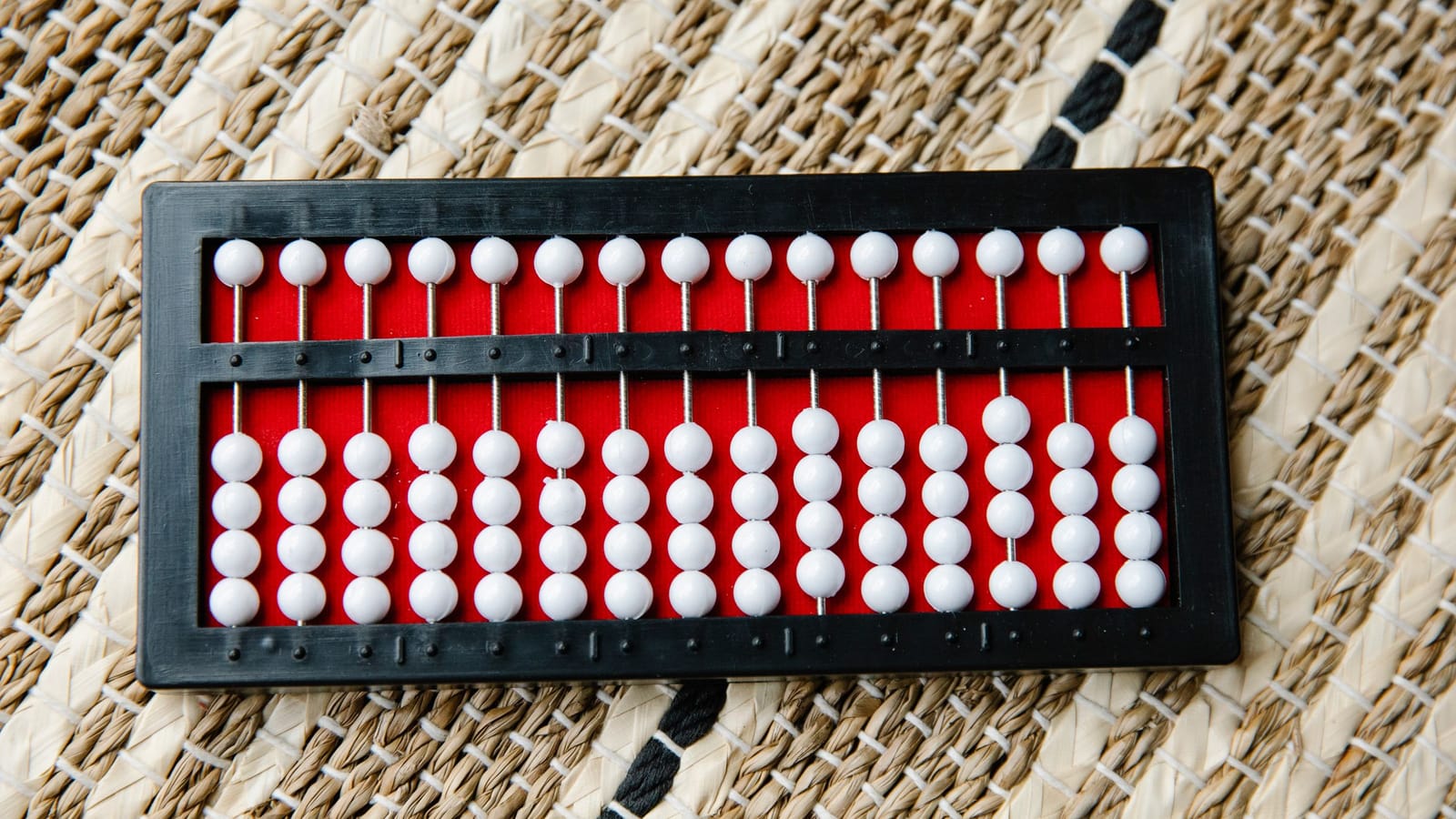
A soroban represents a number in columns of beads, one column per place value. Users first learn to calculate by moving the beads with their fingers, then gradually stop using the physical abacus and move imagined beads instead.
Michael Frank and David Barner studied the representations behind this skill in children in India who had learned mental abacus [1]. Their results suggest the imagined abacus is held in visual working memory by splitting it into columns, each stored as a separate unit with its own detail. Practised users' calculations were relatively insensitive to verbal interference, which fits the idea that mental abacus is a non-verbal format for exact calculation [1].
This is why flash anzan looks so different from ordinary mental arithmetic. An abacus user does not keep a spoken running total ("forty-seven, seventy-two, fifty-four…"); they update a picture of beads after each number.
| Ordinary mental addition | Mental abacus (anzan) | |
|---|---|---|
| Representation | Words and digits, often spoken silently | An imagined abacus with bead positions |
| Running total | Held as a number | Held as the state of the beads |
| Effect of talking at the same time | Usually disruptive | Relatively little disruption in practised users |
| Main limit | Carrying and holding partial results | How many columns can be held in visual memory |
These are research descriptions of mechanism. They explain how experts calculate; they are not evidence that learning the method improves other abilities.
What happens when children learn it?
The strongest study is a randomised controlled trial by David Barner and colleagues [2]. In a school in Vadodara, India, 204 children aged about 5 to 7 at the start were randomly assigned either to mental abacus lessons for three hours a week or to three hours of supplementary standard maths, so both groups received the same amount of maths teaching. The children were followed for three years.
- Arithmetic improved. The abacus group outperformed controls on arithmetic tests, including a standardised calculation test, and the advantage began within the first year [2].
- Basic cognitive abilities did not change. Spatial and verbal working memory, mental rotation, number comparison and a reasoning test (Raven's matrices) showed no reliable effect of training by the end of the study [2].
- Not every child benefited. Children who started with low spatial working memory did no better than controls; those above the median made large gains on arithmetic [2].
The authors concluded that expertise came from using existing abilities efficiently rather than from changing them. The children received over 100 hours of instruction, which is very different from a few minutes of a flash-sum game.
A worked example
Try this as it would appear in a basic flash round. Read each number once, then cover it.
3 · 8 · 5 · 9
The total is 25 (3 + 8 = 11, + 5 = 16, + 9 = 25).
A harder round mixes two-digit numbers and subtractions:
47 · 25 · −18 · 63 · −32
Show the running total
47 → 72 (+25) → 54 (−18) → 117 (+63) → 85 (−32).
If you have no abacus training, you probably kept a verbal running total. That is a perfectly good way to play, but it is not anzan: you are practising mental addition under time pressure.
How LaserMind's Flash sums mode works
Flash sums is a mode of the Mental Math exercise. Numbers appear one at a time with a quarter-second gap between them; you then type the total.
| Level | Numbers | Digits | Subtractions | On screen |
|---|---|---|---|---|
| 1 | 4 | 1 | no | 1.0 s |
| 2 | 5 | 1 | no | 0.9 s |
| 3 | 6 | 1 | no | 0.8 s |
| 4 | 4 | 2 | no | 1.1 s |
| 5 | 5 | 2 | no | 1.0 s |
| 6 | 5 | 2 | yes | 1.0 s |
| 7 | 6 | 2 | yes | 0.9 s |
| 8 | 8 | 2 | yes | 0.7 s |
| 9 | 4 | 3 | no | 1.1 s |
| 10 | 6 | 3 | yes | 0.9 s |
- One digit means 1–9, two digits 11–89 and three digits 101–899. The first number is always positive, the running total never drops below zero, and the same number never appears twice in a row.
- A round has 10 sums. A correct total moves you up one level; two misses in a row move you down one.
- Your result shows how many sums you got right, the highest level you answered correctly and a flash score: the sum of the levels of your correct answers, up to 100.
- In Kids mode the numbers stay on screen longer.
The mode is designed for people with or without abacus training. It does not teach the soroban.
Can adults learn flash anzan?
Adults can learn the soroban and mental abacus, but the research above was done with children in a school programme over three years [2]. We found no trial in adults. If you want the real technique, learn the physical soroban first; a flash-sum game alone will train a running total, not bead imagery.
What the research says
Try it on LaserMind
▶ Mental Math SprintChoose Flash sums. Play ten rounds, then compare your highest correct level with your own earlier sessions.
For everyday calculation strategies without an abacus, read Mental math tricks that actually help.
What research has not established
The randomised trial was carried out in one school in India with children from relatively disadvantaged backgrounds, and the authors note that the amount of training needed, and results in other populations, remain open [2]. The mechanism studies involved trained children and describe how the skill works, not its benefits [1]. We did not find trials of flash anzan itself as a format, or of mental abacus in adults. LaserMind's Flash sums mode has not been tested as an intervention, and its levels are not norms or grades used by abacus associations.
Frequently asked questions
Is flash anzan the same as soroban?
No. The soroban is the physical abacus. Anzan is calculating with an imagined abacus, and flash anzan is a drill in which the numbers are flashed on a screen.
Do I need an abacus to play a flash-sum game?
No. Without abacus training you will add the numbers in your head in the usual way. That is still useful practice for the game, but it is a different skill from anzan.
Does abacus training make children smarter?
The best trial so far found better arithmetic but no change in working memory, spatial skills or a reasoning test after three years [2].
References
- Frank, M. C., & Barner, D. (2012). Representing exact number visually using mental abacus. Journal of Experimental Psychology: General, 141(1), 134-149. https://doi.org/10.1037/a0024427
- Barner, D., Alvarez, G., Sullivan, J., Brooks, N., Srinivasan, M., & Frank, M. C. (2016). Learning mathematics in a visuospatial format: A randomized, controlled trial of mental abacus instruction. Child Development, 87(4), 1146-1158. https://doi.org/10.1111/cdev.12515
- Simons, D. J., Boot, W. R., Charness, N., Gathercole, S. E., Chabris, C. F., Hambrick, D. Z., & Stine-Morrow, E. A. L. (2016). Do "brain-training" programs work? Psychological Science in the Public Interest, 17(3), 103–186. https://doi.org/10.1177/1529100616661983