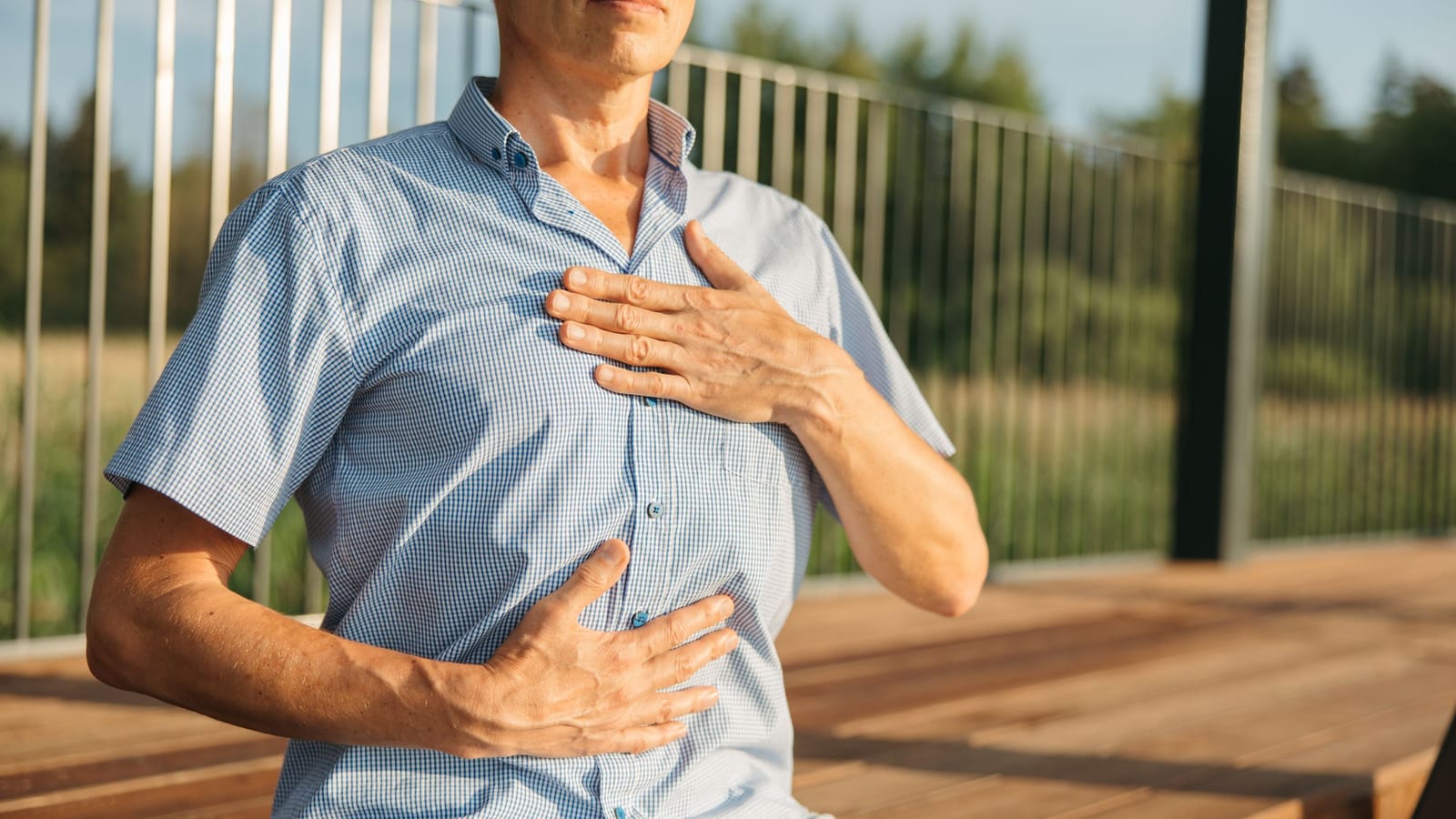
What slow breathing is
Slow breathing means deliberately slowing your breathing, gently, to fewer than 10 breaths a minute, which is how a systematic review of the research defined it [2]. A common pattern is to breathe in for about 4 seconds and out for about 6: one breath every 10 seconds, or six a minute.
It is not the same as taking deep breaths, holding your breath, or fast breathing techniques. The aim is a pace that stays comfortable, with an out-breath a little longer than the in-breath.
Why it may help
The research on slow breathing measures three kinds of outcome, and they are worth keeping apart.
| Outcome | What the studies found | How strong |
|---|---|---|
| How stressed or relaxed people feel | Lower self-reported stress than controls; more comfort and relaxation, less anxiety | Moderate: many small trials, moderate risk of bias [1][2] |
| Body measures such as heart-rate variability | Higher during slow breathing, just after a session and after multi-session programmes | Large body of studies; a physiological marker, not a health outcome in itself [3] |
| Attention and focus | One small trial; within-group gains, no significant difference from controls after training | Weak [4] |
Feeling calmer. A 2023 meta-analysis pooled randomised trials that compared breathwork with non-breathwork control conditions. Across 12 trials and 785 adults, breathwork was linked with lower self-reported stress, with an effect size of g = −0.35, small to medium [1]. Similar effects appeared for self-reported anxiety (20 trials) and depressive symptoms (18 trials) [1]. When the authors split trials by technique, the ten slow-paced trials showed the same effect (g = −0.35); the two fast-paced trials were too few for a meaningful comparison [1].
A 2018 systematic review of slow breathing in healthy people found 15 studies that met its criteria, out of 2,461 abstracts screened [2]. Across them, slow breathing went with more comfort, relaxation, pleasantness, vigour and alertness, and fewer symptoms of arousal, anxiety, depression, anger and confusion [2].
What happens in the body. The same review reported higher heart-rate variability, the beat-to-beat variation in heart rate that rises with the "rest and digest" side of the nervous system, along with changes in brain activity measured by EEG [2]. A larger 2022 meta-analysis of 223 studies found that voluntary slow breathing increased vagally mediated heart-rate variability during a session, immediately after a single session and after programmes of several sessions [3]. Those are body measures. They help explain why slow breathing might feel calming, but they are not proof that it improves health or thinking.
Focus. This is where the evidence is thinnest. In a study of 40 healthy adults working at an IT company in Beijing, participants were randomly assigned either to 20 sessions of breathing training over eight weeks at an average of about 4 breaths a minute, using a feedback device, or to a control group [4]. The training group improved on a number-cancellation attention test compared with their own starting point, and reported less negative emotion [4]. But the control group, which received no training, also improved, and the two groups did not differ significantly after training [4]. One small study with a no-training control cannot show that slow breathing improves attention.
A more realistic reading: slow breathing may help you feel settled before a task, and feeling settled may make it easier to start. That is a reasonable thing to try, not a proven focus technique. If attention is your main goal, our review of whether meditation improves attention looks at a related and better-studied question.
How to practise slow breathing, step by step
These steps follow the Slow Breathing method guide. The pace is a suggestion, not a rule.
- Get comfortable. Sit or stand, relax your shoulders and breathe gently, through your nose if that is easy.
- Breathe in for about 4 seconds. Do not try to fill your lungs completely.
- Breathe out for about 6 seconds. Let the out-breath be slow and easy, not pushed.
- Adjust. If that pace feels uncomfortable, shorten it, or simply breathe a little more slowly than usual. Any comfortable slow pace is fine.
- Keep it short. A few minutes is enough, for example before a stressful task or when you notice tension building.
- Return to normal breathing when you finish, and notice how you feel, without expecting a dramatic change.
You can count silently, or follow a visual pacer such as the breathing circle in our Breath Counter, described below.
Common mistakes
Breathing too deeply. Very large breaths can leave you light-headed. Slow and gentle matters more than exact timing. In a trial with 60 healthy undergraduates, a 20-minute recorded deep-breathing session raised self-reported relaxation compared with a control group who read magazines, but physiological arousal, measured by skin conductance, rose at first before returning to its starting level [5]. "Relax by breathing" can take a little while to feel relaxing.
Forcing the count. If 4 and 6 seconds feel like a strain, the count is too long for you right now. Shorten it.
Holding your breath. Breath-holding is not part of slow breathing, and the guidance on our tools is never to hold your breath.
Expecting it to fix the cause. Slow breathing is a short-term way to settle. It does not change what is causing the stress, and the trials measured how people felt [1].
Treating it as treatment. The meta-analysis authors describe breathwork as possibly effective for stress and mental health, but urge caution and better-designed studies to avoid a mismatch between hype and evidence [1]. If stress, anxiety or low mood is affecting your daily life, talk to a doctor or another qualified professional.
Who should be careful
The meta-analysis found no reported adverse events or lasting bad effects directly attributed to breathwork, though one included study reported side effects such as shortness of breath and sweating in a small subgroup, and the authors called for more research on safety, particularly for fast-paced techniques [1]. They also advised that breathwork might worsen symptoms in people with some mental or physical health conditions [1].
So, sensibly: if you have a breathing condition such as asthma or COPD, a heart condition, are pregnant, or are prone to panic attacks, ask your doctor before trying breathing exercises. For everyone, stop and breathe normally if you feel dizzy, light-headed, tingly or anxious.
What the research says
Try it with the Breath Counter
LaserMind's Breath Counter began as a breath-counting exercise: you tap the circle, or press Space, on each out-breath and count either 1 to 10 three times or 1 to 100. If you lose count, you press "I lost count" (or L) and start again from 1; noticing that you drifted is the point of the exercise, not a mistake. You can hide the number to make it harder. At the end it shows how many breaths you counted, how many minutes it took and how many times you noticed your mind wandering. The method behind it is described in Breath Counting, and why minds drift is covered in what mind-wandering is.
For slow breathing, turn on the optional "Breathing circle 4s/6s". The circle grows as you breathe in for about 4 seconds and shrinks as you breathe out for about 6, a ten-second cycle. If your device is set to reduce motion, the circle shows the same timing by changing colour instead of size. Follow it only while it feels comfortable. The tool reminds you to never hold your breath and to stop and breathe normally if you feel dizzy. It does not measure your heart rate or stress, and it has not been tested in trials of its own.
Try it on LaserMind
▶ Breath Counter & PacerTurn on "Breathing circle 4s/6s" and follow it for two or three minutes before a task.
Try it on LaserMind
▶ Deep Work TimerAfter a few slow breaths, start one 25-minute block on a single task.
For how stress affects memory and attention in the first place, see How does stress affect attention and memory?, and for why there is no ideal stress level to aim for, What is the Yerkes-Dodson law?.
What research has not established
- The trials measured how stressed or relaxed people said they felt [1][2]. They do not show lasting changes or effects on health.
- Many studies were small, and most breathwork trials had a moderate risk of bias [1]. Participants usually know whether they are doing a breathing exercise, which can shape what they report.
- The systematic review of slow breathing included healthy people only [2], and the deep-breathing trial used 60 undergraduates in one session [5].
- The only attention trial we found was small, had a no-training control and did not find a significant difference between groups after training [4].
- Heart-rate variability is a physiological marker. A rise during slow breathing does not by itself mean better health or better thinking [3].
- LaserMind's Breath Counter is a practice tool. It has not been evaluated in trials and is not a medical device.
Frequently asked questions
How long should I breathe slowly? A few minutes is a practical start, for example before a stressful task. Trials used different lengths, from a single 20-minute recorded session [5] to 20 sessions over eight weeks [4], so there is no proven ideal duration.
Is 4 seconds in and 6 seconds out the best pace? It is a comfortable example that gives six breaths a minute, within the under-10-a-minute range the systematic review studied [2]. Studies have not shown that one exact pace is best for everyone, so use whatever slow pace feels easy.
Does slow breathing help you concentrate? Possibly by helping you feel calmer, but direct evidence is weak: in the one small trial we found, attention improved in both the breathing group and the no-training control group, with no significant difference after training [4].
Is slow breathing safe? For most people it is gentle, and the meta-analysis found no reported adverse events directly attributed to breathwork [1]. Stop if you feel dizzy, never hold your breath, and ask a doctor first if you have a breathing or heart condition, are pregnant or are prone to panic.
What the research says
Last evidence check 2026-11-12A meta-analysis of 12 randomised trials with 785 adults found breathwork was linked to lower self-reported stress than control conditions (a small-to-medium effect); most trials had a moderate risk of bias and the authors urge caution. Health [1]
A systematic review of 15 studies found slow breathing was linked with more comfort and relaxation and less arousal and anxiety in healthy people, alongside higher heart-rate variability. Health [2]
References
- Fincham, G. W., Strauss, C., Montero-Marin, J., & Cavanagh, K. (2023). Effect of breathwork on stress and mental health: A meta-analysis of randomised-controlled trials. Scientific Reports, 13, 432. https://doi.org/10.1038/s41598-022-27247-y
- Zaccaro, A., Piarulli, A., Laurino, M., Garbella, E., Menicucci, D., Neri, B., & Gemignani, A. (2018). How breath-control can change your life: A systematic review on psycho-physiological correlates of slow breathing. Frontiers in Human Neuroscience, 12, 353. https://doi.org/10.3389/fnhum.2018.00353
- Laborde, S., Allen, M. S., Borges, U., Dosseville, F., Hosang, T. J., Iskra, M., Mosley, E., Salvotti, C., Spolverato, L., Zammit, N., & Javelle, F. (2022). Effects of voluntary slow breathing on heart rate and heart rate variability: A systematic review and a meta-analysis. Neuroscience & Biobehavioral Reviews, 138, 104711. https://doi.org/10.1016/j.neubiorev.2022.104711
- Ma, X., Yue, Z.-Q., Gong, Z.-Q., Zhang, H., Duan, N.-Y., Shi, Y.-T., Wei, G.-X., & Li, Y.-F. (2017). The effect of diaphragmatic breathing on attention, negative affect and stress in healthy adults. Frontiers in Psychology, 8, 874. https://doi.org/10.3389/fpsyg.2017.00874
- Toussaint, L., Nguyen, Q. A., Roettger, C., Dixon, K., Offenbächer, M., Kohls, N., Hirsch, J., & Sirois, F. (2021). Effectiveness of progressive muscle relaxation, deep breathing, and guided imagery in promoting psychological and physiological states of relaxation. Evidence-Based Complementary and Alternative Medicine, 2021, 5924040. https://doi.org/10.1155/2021/5924040