
Put the idea into practice
Try Spot the Difference
Play 27 scenes in sequence, starting with three differences. No time limit; reveal a spot whenever you get stuck.
Find them all to see Level complete, then press Next level.
More targets and a harder search are different questions
Finding every change in a ten-difference puzzle means making more distinct finds than in a five-difference puzzle. That fact alone does not tell you how difficult each find will be or how long the whole attempt will take.
A large change to an isolated object and a small change inside a crowded region present different comparisons. Counting targets leaves those differences out. A useful difficulty description therefore includes what changed, how visible it is and what surrounds it.
A review of visual search describes influences on guidance such as features, scene context and search history [1]. It provides background for considering the display, rather than a formula converting target count into puzzle difficulty.
Compare two changes to the same original
This original LaserMind teaching board contains twenty numbered items. Each starts as a circle with a dot to the left of its centre. The numbers help you check the answer and are identical across versions.
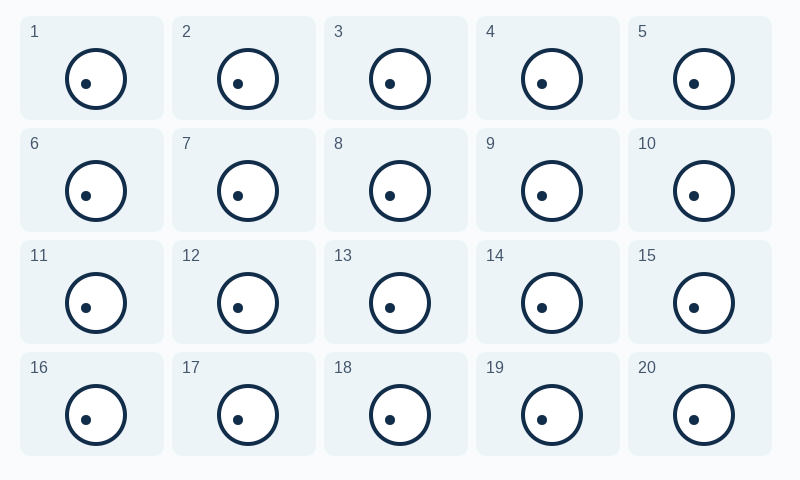
Open either version and compare it with the original. You can enlarge the diagram using the browser; the activity has no timer or saved score.
Compare the version with five interior changes
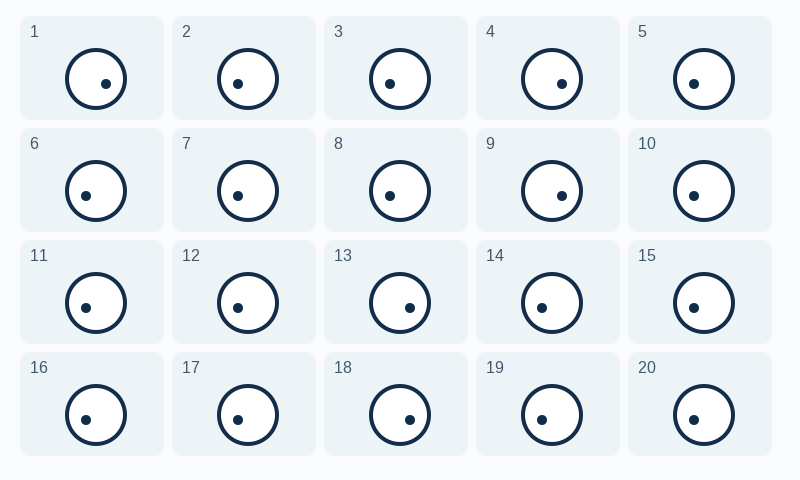
The changed items are 1, 4, 9, 13 and 18. Their dots move from the left to the right of the centre. All twenty circular outlines stay unchanged.
Compare the version with ten outline changes
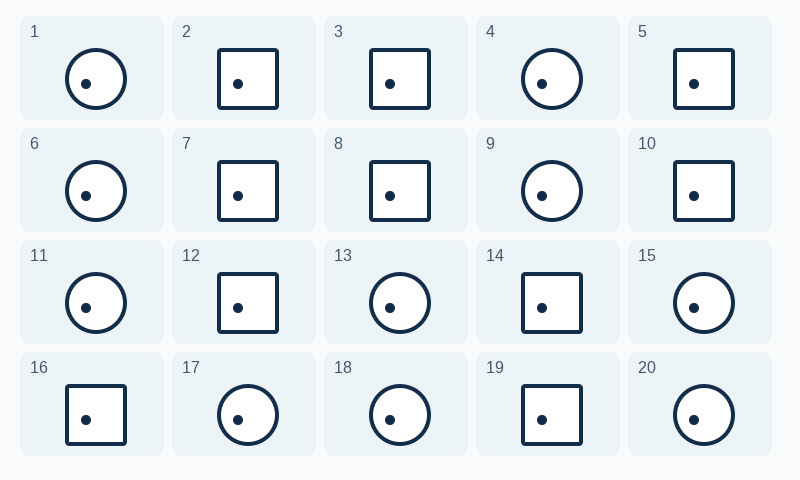
The changed items are 2, 3, 5, 7, 8, 10, 12, 14, 16 and 19. The remaining outlines and every dot position stay the same.
The number of changed items is exact because the diagrams are generated from the same specification. Their difficulty has not been measured in a participant study. We deliberately vary change type and extent as well as count, so the example cannot isolate the effect of count alone.
Describe the other ingredients
| Ingredient | Comparison to make |
|---|---|
| Extent of change | An interior detail or the main object outline? |
| Similarity | Does the changed detail resemble surrounding details? |
| Clutter | How many competing details share the region? |
| Placement | Is the change isolated, near another object or partly obscured? |
| Display | At what rendered size are the details being compared? |
| Familiarity | Has the player seen the scene or answer before? |
These are useful design and interpretation questions. The table does not assign a universal weight to each factor or claim that one always matters more than another.
How to make a fair count-only comparison
If you want to investigate the effect of five versus ten targets, preserve the scene and make the changes comparable in kind and visibility. Define the stopping rule and assistance, collect results from appropriate independent attempts and report mistakes as well as time.
Even then, a person who has already inspected a scene may remember objects or answer locations. Treat different versions derived from the same original as related exposures. Randomly presenting the same scene again does not make it unfamiliar.
Our illustration is a teaching comparison, so remembering its numbered answers is expected. It should not be used as a baseline attention test.
Choose a challenge by readability and interest
Start with a scene whose details you can see comfortably. Read the number of changes, compare matching areas and use assistance if you want it. If the activity becomes a search for compression noise or an almost invisible line, choose a clearer display or enlarge it.
Use spot-the-difference search strategies to organise the comparison. For tasks focused on individual attributes, try visual discrimination activities.
Try it on LaserMind
▶ Spot the DifferenceCompare two scenes and select each difference. Review your active search time and accuracy, and keep replays and assisted attempts in context.
What research has not established
The diagrams establish the number and location of their edits, not an empirical difficulty ranking. No completion-time study, population norm or comparison of player groups was performed. Change type and extent differ intentionally between versions, so the display does not show a causal effect of count. Browser scaling and repeated exposure also affect how it is inspected. The activity has no saved or scored result.
Frequently asked questions
Is a ten-difference puzzle always harder?
It has more targets to find, but the target count does not specify how difficult each comparison is. Check the display and change properties too.
Which version of the teaching board is harder?
We have not measured that. The purpose is to show why the count alone leaves important information out, not to declare a winner from intuition.
Can I compare my time on two versions of the same scene?
You can record it, but label the shared scene and previous exposure. Familiarity can contribute to the second attempt; see how to read puzzle results.
References
- Wolfe, J. M., & Horowitz, T. S. (2017). Five factors that guide attention in visual search. Nature Human Behaviour, 1, Article 0058. https://doi.org/10.1038/s41562-017-0058